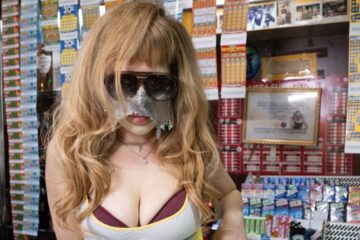
WEEKEND MUSIC TIP PT 99 – M¥SS KETA
M¥SS KETA under Nonni surveillance - …



“I need projects that are completely my own.”
CHELO moves through music, fashion and community with a kind of quiet confidence that makes everything he does feel intentional without ever feeling forced. Born near Munich and long woven into Germany’s creative scene, he first appeared through SAM, the project he shared with his brother. Today his work extends far beyond that chapter, unfolding inside a world he has built piece by piece.
At the center is thatboii, his creative label and the connective tissue for everything he touches: concise clothing drops, distinctive event formats and a visual language that stays remarkably consistent. Nothing about it feels loud. It simply feels precise.
secret.session is one of the formats that shaped his recent years. The all-black dress code, the last-minute locations, the crowd arriving already aligned creates a mood before the night even begins. It is not about exclusivity. It is about everyone stepping into the same atmosphere at the same time.
Then there is sundaiitape, the filmed sessions that place CHELO on the floor, surrounded by a circle of guests at eye level. The camera barely announces itself. The format works because it feels effortless: no performance, no hierarchy, just a room, a set and an energy that people connect to even online.
His newest project opens yet another lane. On a small vinyl-listening tour through German cities, CHELO brings together around thirty people to listen to records that mark parts of his life: the first vinyl he ever bought, artists who shaped his way of hearing, and a particularly personal piece, a vinyl he created after his brother Sam’s passing, pressed from unreleased music as a way of honoring him. Winemaker Matthias Knebel pairs each chapter of the evening with a wine chosen for a specific emotional tone, three moods that quietly guide the night.
Across everything he does there is an ease, a sense that things do not need to be rushed to be powerful. The work is about atmosphere, about bringing people into a space where they can actually feel something without overexplaining it.
In our conversation, we talk about his beginnings, the evolution of his sound, the world he builds under thatboii and the cultural and emotional spaces he is only beginning to open.
CHELO: I don’t think there was one single moment. It was more of a slow build. I started playing drums early, ten years of practice, sheet music, Jugend musiziert. It was fun, but also exhausting, almost like doing something because you are supposed to. I felt it more when I played at home.
Later, playing in my own band, I could bring in my own ideas. When I started DJing, a new layer appeared because you get direct feedback from people. Even if it is not your track, you communicate with them, and I always loved that. Then you begin producing your own music and watch how people react at shows. That is another step again.
So no big moment. But very early on I knew that music is something magical. And with every project I keep rediscovering that feeling.
C: I have been DJing for a long time, around twenty years now, and the landscape has changed a lot. Back then everything felt very defined in my head. There was hip hop, rock, pop and then everything else. Hip hop felt like its own world, with its own parties and a very specific style.
Today the boundaries are much softer. Genres blend into each other, which I actually really like. I am open to a lot of sounds, but my hip hop roots are still the foundation. When I play, I try to bring that spirit with me: classics, RnB tracks people might not hear anymore, mixed with whatever feels current. I want a set that a 21-year-old can connect to, but where a 35-year-old also feels understood. That is the range I naturally move in.
Influence-wise, Pharrell Williams was a major one for me. He had the perfect combination: his style, his taste, the productions he worked on, it all felt exactly right to me. He was ahead of the curve, also in fashion. Later I had a project with a live band that pushed me back into a more rock-oriented sound, and I was playing drums again. That shaped me too. Pharrell always stayed a reference point. A sexy motherfucker. Maybe not as much today, but still a lot.
C: Da Rockwilder by Method Man and Redman.
C: It is still pretty new for me to go back to playing vinyl, and at the beginning it is honestly very exhausting. But it is a completely different way of playing and experiencing time, of letting go, of moving. When I play digitally in a club, everything feels as fast as life today. People listen to thirty seconds of a track and already wait for the next one. It was not like that back then.
With vinyl I try to bring that feeling back, where you actually listen to a song from beginning to end. The appreciation for the music returns and the whole room relaxes. The pressure, the expectations, the energy shift in a really nice way. I did not know what would happen when I tried it again, but it became something special. A different way of going out, of dancing, of listening together.
Even the volume changes. It is not as loud as in a club, and the energy in the room becomes something calmer and more intentional. I am not sure yet where this will lead, but I felt something in that room, a very particular energy, and I really liked that.
C: At first it happened by accident. For the first sundaiitape I sat on a stool because the idea was to keep everyone on the same level. No stage, no hierarchy.
In Paris we did not have a stool that made sense, so I said I would sit on the floor. And the atmosphere changed immediately. The circle felt tighter, more intimate, almost sealed. The energy became something else.
From the outside it can look strange, but once you are in the room it clicks. Whether you are playing or listening, there is a quiet closeness that forms only in that setup. That is what I want sundaiitape to be: an intimate space where the music and the moment carry everything.
C: For sundaiitape it is always about the room, the people and whatever feeling is present in that moment. I can only prepare on site. I need to see the space, feel the energy. Most of the time I am still putting the set together two hours before, while guests are already arriving. That is the only way it works for me.
What surprises me is how this very intimate atmosphere somehow translates digitally. The feedback I get is often that people can feel something through the screen, which is crazy because the setup is so small, quiet and a bit magical. Usually, the presence of cameras destroys that feeling.
But we only use one camera, and it is always the same person filming – Kwami. Just him. No crew, no production energy. I do not feel comfortable with ten people behind a camera; it changes everything. With one person, you barely notice the filming, and the atmosphere in the room stays real. I think that is why it works on video too. The energy stays untouched.
C: It developed naturally, but in the end it is about community. When everyone wears black, the room falls into one visual language. Black is sexy. Not too much, just a little sharper. It elevates the atmosphere.
It also connects people. It is not deep philosophy, but you feel a kind of unity. If you show up in a white shirt, you stand out instantly. You are not fully part of the moment.
It is a small detail, and sure, in summer it can be annoying, but staying consistent builds something. People commit to it, and that commitment strengthens the community.
It also slows things down. Today people go out without thinking much, they do not commit. With secret.session you prepare, you choose a fit, you follow the updates, you get your ticket. It creates a subtle sense of belonging.
We also stepped away from the usual guest-list culture. Before, people would say they were coming and not show up. Now the ones who want to be there actually come, even the ones who used to be on the list. It makes the night feel more intentional. And keeping it small preserves the energy. Whenever we made it bigger, the atmosphere shifted.
C: I try not to change myself too much. Whether I am in a room alone with one or two webcams or in a space with twenty people and proper cameras, I want to stay the same and focus on the music.
The whole webcam thing started during Covid. Everyone bought webcams and streamed DJ sets, but I did not want to do it in a typical way. I played in a flower shop, on my sofa at home, in a retail store. Places that were empty anyway. I always tried to make something visually nice out of whatever room was available. Aesthetics were important to me even then.
After Covid, when I could finally invite people again, I started searching for even better locations. That is how everything slowly evolved. But what I want to keep from that time is the simplicity. One camera, one idea, one feeling. That is still the core of everything I do.
C: It depends a lot on the people. When you play in London, for example, you can usually expect a different kind of cultural background than when you play in Leipzig. You feel that immediately. But I do not really prepare sets far in advance, because I need to know who is actually in the room. I need to see the space, feel the energy. That is why most of the time I only prepare two hours before, while the guests are already arriving.
A lot happens live for me. I communicate with people through the music and try to find a level where we can have a good night together. If that connection is there, the city almost does not matter. If it is not there, it becomes difficult. That is why I am more careful now and try to play in places where I know the match will be right. The concepts I do and the way everything looks online already filters who reaches out anyway, so most of the time it fits naturally.
“I want to build spaces that feel real, spaces where people can actually breathe and connect.”
C: There are boundaries everywhere, especially financial ones. In fashion you often have ideas you simply cannot realise because the fabrics are too expensive or the minimum quantities are impossible. That used to frustrate me a lot. My dream was always to have complete creative freedom, a room full of tailors, endless materials, the ability to just try things. I never had that, and most people do not in the beginning.
Music works in a similar way. In an ideal world I would walk into a studio with twenty musicians and experiment freely, but that is not reality either. And then there is the outside noise, people telling you something will not work or does not make sense. I try not to let that shape my decisions.
When you collaborate with brands, there are always compromises, even when the teams are great and open. That is why I also need projects that belong entirely to me, where nothing has to be justified in advance and the process can unfold on its own. That is usually where the special things happen.
By the end of last year I felt that very clearly. I realised I needed something that was not about output or performance metrics or whether it lands online. I needed something for myself and for a few people who genuinely want to be part of it. That kind of work feels the most honest.
C: It is not always easy to know if a collaboration truly fits. You have your own taste and your favourite brands, of course, but for me the most important part is always the people. If I feel that the team behind a brand understands me and we are on the same wavelength, then I actually want to work with them. The concept and the brand itself have to make sense too, but the people come first. You spend time with them, you build projects together, so that connection has to be real. And so far I have been very lucky with that.
C: I studied primary and secondary education for a few semesters, subjects like math, music and economics. The program was very hands-on, so once a week I was actually in a classroom teaching kids. That time shaped me in ways I did not fully understand back then.
Before that I had worked in an orphanage in Brazil and later in a school for children with intellectual disabilities in my hometown as part of my civilian service. Experiences like that leave marks. They change how you see people, how you understand groups, how you communicate. Not in one specific, easy-to-name way, but in a quiet way that becomes part of you.
I always liked working with kids and showing them things, which is why I started studying teaching in the first place. But at some point I realised that the system around it is very fixed. It is a structure you have to move inside, and I felt that limitation more and more. I knew I wanted freedom, the ability to shape my life creatively and keep evolving. That is why I stepped away.
But the time with the kids, the responsibility, the human side of it, the way you learn to read a room and guide it, all of that stayed. It is still in me when I create spaces today, whether it is an event, a tape, a session or something completely new.
C: I am not sure if it is a physical space I want to open next, but I know I want to produce music again and release it. When you put new music into the world, new spaces appear around it naturally. They shape themselves.
I do not have a long list of goals. I just want to keep evolving. In music, in creativity and especially with people. That is what I feel the most right now. I am not someone who loves talking for hours, but that is exactly why I started these small listening sessions. They push me. They force me to speak, to share, to grow. They change the way I handle music and also the way I handle people.
The connection between music and people is something I find beautiful. People in general. There is so much potential in that if you create the right conditions for it. What is missing today is being together in a real way, being part of something, moving as a team instead of everyone drifting on their own.
A lot feels superficial at the moment, especially in the fashion world. I do not want to stay in that energy. I want to build spaces that feel real, spaces where people can actually breathe and connect. If I can keep creating that, in whatever form it takes next, then I am exactly where I want to be.
M¥SS KETA under Nonni surveillance - …

For Massimiliano Pagliara, music is more than a collection of genres and influences. We…

“I just love being a mother“ - Miss Bashful on her newest album, toxic relationships…