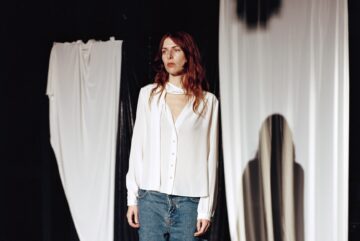
WEEKEND MUSIC PT. 86 – LAUREL HALO
Laurel Halo soundtracks Julian Charrière’s exhibition Midnight Zone, following a lens…



DUA SALEH: “I’VE ALLOWED PEOPLE TO SEE EVEN DEEPER INTO MY PERSONAL WORLD”
This coming May, Dua Saleh will release the new album Of Earth and Wires, continuing the narrative they began on the previous album I Should Call Them. The last Album started the story of two lovers, who are now navigating through an apocalyptic landscape of ruins after the collapse of society. In this work, Saleh explores existential questions regarding identity, the ways love keeps us together, and the destruction of our earth.
As a deep and reflective personality, Dua Saleh engages intensely with global developments, from the rapid rise of AI to the wars in their home country, Sudan, and the political unrest in their adopted home, the USA. Issues that are currently preoccupying and shaping our society. The album is a direct result of this confrontation, coupled with feelings of isolation and loss.
Sonically, Saleh deconstructs and combines indie, R&B, and electronic pop with elements of Sudanese folklore, UK dance, and Baile Funk. The singles Flood and Glow provide a first glimpse into the project. Both tracks were created in collaboration with Bon Iver, an artist Saleh admired during their school days and values today as a collaborator and musical genius.
Continuing the story started in their previous work, this album feels more emotionally transparent. Music remains their most natural outlet for vulnerability, allowing them to process the complexities of having multiple homes over the past few years, a journey that forced them to redefine the very concept of home. Their creative process is deeply intentional, rooted in an intense connection to their emotions.
DUA SALEH: Yeah, I feel that sometimes when we focus our energy on a specific sound, the music eventually comes to you because you surround yourself with like-minded people. We were both in Minneapolis, even though we both make music that is outside of our typical genres, his being folk and mine being Indie Pop or R&B. I’m only just venturing into folk now with Bon Iver. Being in similar circles in the same city and connected through the music community in Minneapolis and Minnesota really helped. To my knowledge, he lives between Minnesota, Wisconsin, and Los Angeles. I remember listening to him a lot back in middle or high school; I was hyper-focused on his music and thought his live performances were outstanding. It feels like the universe brought him to me because I hadn’t actually met him before we started working together. I just received a random text from him.
DS: Yeah, I was geeked! I was like, ‘What the heck?’ It was crazy, but it made sense because my friend Simon, who executive produced three of my albums, exists within the same circle of music producers and creatives in Minnesota and Minneapolis. So, he gave him my number, and then I sent over my verse for a song we did.
DS: Yeah, it felt a bit intimidating at first because he’s a genius. Seriously, the first time we met, he was freestyling on probably five or six songs we did together. I was just sitting back, letting people produce and play the drums, while feeling completely overwhelmed. I was thinking, ‘Oh my gosh, this is an icon.’ Because I felt so intimidated, I didn’t write to the music right away. I waited, let my emotions settle, and allowed myself to be guided by his voice, really listening to what he was saying, applying it to my life, and asking myself: ‘How does this make me feel? What does this remind me of?’ He’s just very special. I’m so excited to be in the studio with him while he’s producing, singing, and just being a ‘nerd’ about it. I think that’s pretty cool.
DS: Thinking back to high school, I was on the debate team and never went to parties because my family was religious. I spent my time in after-school programs and minded my own business, but my grades weren’t the best. I did really well on tests, so I was still able to earn college credits, but I was definitely a ‘slacker nerd’, I would often fall asleep during class.
DS: I feel neutral toward it, mainly because in a dystopian world, the physical Earth prospers regardless. Even if it’s a dystopia, once that is gone, only the Earth remains, plants, vegetation, and water. The globe can take care of itself once the ruins of humanity are gone. So, I don’t think it’s strictly good or bad. Obviously, as a human being, I have empathy and wouldn’t want that to happen; it wouldn’t be ideal for anyone. It’s not that I want a dystopian world to exist, but I’m imagining what it would be like after all the decay. People would be trying to make sense of themselves and stay true to their identity as humans, but it would be warped by this new world they don’t really remember. That is very similar to how Sudanese people feel, being ripped away from their indigenous culture. For instance, I know my indigenous tribes didn’t necessarily speak Arabic. There were alternative languages they could have spoken, but I don’t even know their names. They might have had a specific religious or spiritual way of life, but I don’t know anything about it, not even how they counted. We have access to history, but so much of it has been destroyed in warfare.
DS: I lived there for the first year of my life, but I moved away shortly after.
DS: No, I figured out pretty early that I was gay, so I’ve always been hesitant. Actually, I ‘jumped the gun’ in a way. I didn’t know what transness was yet, but I remember watching Will & Grace. There was a gay character, and I realized, ‘Oh, you can be gay.’ For some reason, I immediately jumped to the conclusion: ‘I’m a boy.’ I don’t know why that happened, but I identified as a boy for two years straight, starting when I was eight. But then we had some family issues, and my focus shifted. I was more concerned with withdrawing into myself and figuring out where we were going as a family. I didn’t truly focus on my identity again until we gained stability in high school.
DS: Yeah, especially because they only recently abolished the death penalty for gay people in 2020. And honestly, I’m too smart to go back there because I know how impulsive I can be. I don’t like wearing a hijab, it makes me feel dysphoric and it’s not good for my heart. If I were there, I wouldn’t want to be forced into it. They treat you almost like an alien, it’s as if they don’t see your whole life there. To them, you’re just a foreigner. Especially since I live in more progressive places now, such as Minneapolis and Los Angeles.
DS: The album Of Earth and Wires is actually an extension of the story from my first album, I Should Call Them. The first record follows two lovers in an apocalyptic time who survive the ruins after society collapses. Together in this new world, they try to make sense of their surroundings. Even though it’s disorienting and they feel like they are losing their identities, they still know they love each other.
Queerness is resilient; it survives beyond dimensions and time, allowing you to stay true to yourself. Once you love someone, that love endures.
DS: I feel I should maintain this narrative about climate change and, as you mentioned, the theme of decomposition. I see it as a decomposition of identity. They are trying to make sense of themselves and stay true to who they are, but after a while, you begin to forget the old ways. It’s an allegory for the Earth; right now, it feels as though we are constantly living in apocalyptic times. Global climate change is real, the world is deteriorating, and the politics are heinous, it’s just terrible.
DS: I actually live in Los Angeles, but my family is still in Minnesota. I’m very concerned because English isn’t my mother’s first language. We are Sudanese, but we are often perceived as Somali, and there’s a lot of hostility toward that community right now, partly due to the political climate and because ICE is targeting Somali people in Minneapolis. My mom is an educator who works with autistic children in kindergarten. Recently, ICE agents arrived at her school. The school didn’t let them in, so they couldn’t take anyone, but they remained posted outside, waiting. My mom told me they weren’t arresting people at that moment, even though immigrants, both staff and parents, were clearly coming and going. It’s the heart of the community. I worry constantly about my siblings and I call them regularly just to make sure they’re safe. At one point, my mom even warned me to be careful because organizers were saying that phones were being tapped, so she started speaking to me in Arabic. It’s a deep concern for me personally as well, especially as someone who received their citizenship later in life, at 17. It makes me nervous.
DS: Yeah, it’s like the detention camps where people are forced into labor. There are even allegations of sex trafficking involving children, women, and men. It’s absolutely terrifying. I think people understand what’s happening, and Minneapolis is obviously a target because the community is so well-organized when it comes to protesting. They’ve held protests at the Mall of America and shut down highways, even in -40 degree weather. They really have their act together, which makes them a threat to the American elite or the right wing, mostly because other people are inspired by it. It reminds people that we should actually be there for our neighbors and work together. American citizens are literally willing to die to protect their neighbors from being kidnapped by ICE. It’s horrendous, heartbreaking, and terrifying, but it just goes to show how much people love each other and how they’ve been there for one another since 2020.
DS: My brother was telling me how neighborhoods are becoming self-organized. Each area has its own specific system. They are using private chats to coordinate and prepare for protests. He told me it’s been incredible, people warn each other whenever ICE is on one block or another. Everyone is watching out for their neighbors, making sure food gets to pregnant women and those in need. It sounds exactly like what you said: it feels like we’re living in a war. It has even become a form of political voyeurism for some. I noticed that Minneapolis was nominated for a Nobel Peace Prize, which is wonderful, especially considering how much Trump wanted one. It’s a bit of a ‘slap in the face’ to him, but it also makes me feel uneasy inside. A Peace Prize is being discussed while people are still terrified in their homes, wondering if their five-year-olds or their grandmothers will be taken away to a detention center. In the end, you want more than a nomination. You don’t want to be part of this hypothetical ‘cold war’ or a political spectacle. You just want to exist.
DS: That’s what it feels like for real.
DS: It ties back to the concepts we discussed. Home is the Earth, the entire planet. We’re just happy to exist. But of course, the album is deeply inspired by my real life, especially Sudan. There are elements from Minnesota, for instance, Justin Vernon worked on several tracks and produced much of the record. To capture the Sudanese elements, I brought in an oud player. I also collaborated with Gaidaa, an incredible Dutch-Sudanese R&B artist, she’s a wonderful singer, and I’m so glad to have her on the album. Since I’m based in Los Angeles now, I also worked with Adeline. She’s in LA but originally from Florida; she wrote a book called Florida Water that I’m actually reading right now. I’m a huge fan of her work. Like Justin, she’s Grammy-nominated, though Justin actually has a few Grammys, but that’s an aside. I’ve tried to merge all the elements of my different homes. While filming Sex Education, I lived in Cardiff, Wales, for two years. My life wasn’t just bi-coastal; it was bi-continental, split between the UK and the US. That really shaped my songwriting. I’m processing the different places I’ve lived and seeing how climate change affects each of them. In LA, we had a massive firestorm, and the song ‘Firestorm’ is literally about the aftermath. I wanted to present it in a slightly cheeky way, it’s not a subject to take lightly, but I still want people to be able to ‘vibe,’ enjoy the music, and maybe even clean their house to it. Similarly, the song ‘Flood’ was inspired by me witnessing flash flooding in Cardiff, Wales. It happened so consistently that I was shocked by it. While I wasn’t personally affected in my accommodations for the show, I would see the roads. It’s actually terrifying. It is happening in Los Angeles right now as well, which is spooky because the song just came out, it feels almost too relevant. Beyond that, there’s Minneapolis, where they had the major protests against the oil pipeline they were putting through the Midwest. Talking about the different places I call home, Sudan, for instance. As a war tactic, crops and homes are often burned down, which is devastating for the environment writ large and tragic for the displaced people living there. I’ve been thinking about all these places and how they are all connected to the Earth. It is all sacred, and we should care for it deeply. At the same time, the album doesn’t take itself too seriously, it’s lighthearted in moments. It follows the journey of two lovers navigating their emotions while living in a post-apocalyptic world. They’re just young lovers trying to make sense of their destiny as soulmates or ‘twin flames.’ It’s a love album for the Earth, but also for these two characters in the series I’m writing.
DS: I can see that. I might actually use that as inspiration for future reference!
DS: Don’t worry, I’m definitely going to reference you. Ms. Nowak definitely helped me with that. But my initial thought was actually about AI. Around the time of the Sudanese war in 2019-2020, I was thinking about climate change just as AI was going viral, specifically when it was being marketed as a ‘rapper.’ While AI systems have existed for a long time, the scale we see now is depleting vital resources like water, and I was trying to make sense of that impact. I began imagining a world where humanity is gone and only wires are left hanging from the buildings. If AI takes over but eventually can’t sustain itself, it would simply collapse into ruins. That’s where the title Of Earth and Wires comes from. It represents the parts of the Earth that stay alive, the natural biospheres that survive the conflict, contrasted with the wreckage left behind by a collapsed artificial intelligence. Without humans to direct it, AI would eventually decay because that’s the natural order of the world. Even in a world of ruins and falling asteroids, the humans left behind are still just trying to make sense of who they are.
We are slowly losing our sense of self. I think the same thing is happening to humanity as a whole.
We’re turning to tools like ChatGPT to find our answers, and it is literally decimating the artistic world. I don’t know how it’s affecting journalism, but in music, it’s horrifying. I imagine you might feel the same way.
DS: That’s so real. So much of the world is grappling with that right now. It’s not that technology is always bad. For example, autonomous vehicles like Waymo can offer real safety, especially for trans women. But it’s still detrimental to the planet. While we enjoy these conveniences, people still lack access to clean drinking water. We’re digging deeper into our reserves without considering the long-term impact. I think this is just what people do. We are predictable. If you make things easy, people follow their evolutionary drive to choose the path of least resistance. We think we’re making the ‘smart’ choice, but we’re only thinking about the next three seconds, not the fact that it all might disappear shortly after.
DS: I feel exactly the same way, even on a lighter note. For example, I find myself listening to those ‘Baby Boo’ remixes on TikTok. I think the song goes, ‘She gonna call me baby boo,’ and there are ten or more AI-generated remixes that I end up liking just because they’re too funny to ignore. I try not to engage with AI, even when I’m using search engines, but it’s difficult because it’s so deeply embedded now that I sometimes forget it’s even there. It doesn’t feel fair, it’s being forced on everyone to the point where we can’t help but use it. It’s crazy.
DS: I think usually I don’t talk about my family life, but for this album, I really ventured out. For example, on the song ‘Enemie‘, I say something that doesn’t necessarily put me in the best light. It’s about meeting my father and finding out he’s an ‚a-hole.’ Beyond that, I talk about grief. My grandmother passed away last year, and it affected me intensely. ‘Flood‘ addresses that grief in a way I rarely even discuss with my friends. While my last project let people into my personal relationships, this time I’ve expanded and grown. I’ve allowed people to see even deeper into my personal world.
DS: Definitely, but most of the time I don’t release those songs because they’re just too personal. People are often shocked when I choose not to include certain tracks on an album, but it would be hard for me to navigate that as a human being. We aren’t just empty vessels, we have real emotions.
I have to take precautions because I know how deeply I feel things. I’m a sensitive boy.
DS: Thank you. I really appreciate that. It’s been wonderful talking to you.
Laurel Halo soundtracks Julian Charrière’s exhibition Midnight Zone, following a lens…
Denzel Curry discusses the formation of the hip-hop supergroup THE SCYTHE and the release…
Rochelle Jordan: In this interview, the British-Canadian artist talks about 15 years of…