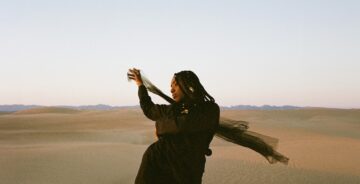
WEEKEND MUSIC PT. 87 – DUA SALEH
Dua Saleh’s upcoming album, Of Earth and Wires, continues an apocalyptic narrative to…



Brooklyn-born Leon Thomas has quietly become one of the defining voices shaping contemporary R&B. Moving fluidly between music, acting, and production, he first entered the public eye through television before steadily building a reputation behind the scenes as a songwriter and collaborator. In recent years, that trajectory has sharpened into something unmistakable: a solo career marked by both commercial momentum and artistic precision. From his debut Electric Dust to the global success of MUTT and its continuation HEEL, his work balances technical control with emotional immediacy, a duality that has earned him chart-topping records, Grammy recognition, and a growing cultural imprint.
In conversation, that balance becomes clear. He speaks with precision, but stays open. Ideas come from fragments like conversations, films, or passing thoughts. What matters is not perfection, but resonance. At a time where success is often external, he focuses on staying grounded, trusting instinct, and keeping a sense of curiosity.
“I think I write some of the best songs for other people when I’m pretending to write for myself”
Leon Thomas: Good. I love Berlin.
LT: I came out here for a promo when I was doing the Nickelodeon show Victorious for the first time. I was like 19. It was a really cool experience then, and then I’ve been back and forth for just shows. I did Colors as well. Yeah, it’s always been a good city for me.
LT: I think if I had a normal job, it would be real estate. I’m really into flipping homes and stuff like that.
LT: I haven’t. I just bought my first investment property. So I’m in the process of remodeling. I’m going to keep it, though. I’m not going to sell.
LT: Yeah. I think in my early 20s, I had the opportunity to continue working on the network, but I knew that I had to separate myself if I wanted to evolve. If I wanted to be taken serious as an artist, I had to spend time working behind the scenes as well, just to really get a good landscape of how to take things to the next level. That’s exactly what I did.
LT: Yeah, It’s always been a constant theme throughout my life.
“I want to keep my inner child alive”
LT: I was very inspired by the neo-soul movement, like Joe Scott, Musiq Soulchild, stuff like that, Erykah Badu, D’Angelo. I think growing up in New York, that was a big thing. The radio really inspired me too, so being with my parents in the car and discovering new music that way was always really nice. Shout out to Hot 97 and Power 105. They definitely raised me. 98.7 KISS FM. I remember all of the radio stations. It was a big part of my culture. It’s what shaped my musical taste as well.
LT: Yeah. I think I write some of the best songs for other people when I’m pretending to write for myself.
LT: Yeah, there’s definitely a couple songs that I wrote that were just for me, but I accidentally played them and then people wanted them for their project. I was like, oh, good.
LT: If it’s stuck in my head. I make a lot of music. I feel like if I can remember the melody, it means that it’s got a mass appeal. It’s the kind of thing that can be catchy. So if it’s stuck in my head after I write it and record it, I usually go back to it. If I can’t remember the hook, it’s probably not catchy enough.
“If I wanted to be taken serious as an artist, I had to spend time working behind the scenes as well”
LT: Beats are very important to me. So yeah, I like to kind of put together different tracks or source different tracks from producers I’m a really big fan of. And then I go sit down and I’ll just do days of writing so I can kind of come up with a bunch of stuff. Sometimes we’ll come up with the track and the song in the same day.
LT: I think the biggest thing that inspire me are conversations about love. If I have a conversation with a homie or even with a girl I’m dating, I’ll write little things down that sound different or that I personally haven’t heard in the song. And I’ll try to find a way to kind of add that in. I think another thing that really inspires me a lot are movies. I’ll play movies on mute while I’m making music. And if the music doesn’t feel cinematic like the film I’m watching, I usually don’t continue.
LT: When I have to turn it in.
LT: A friend of mine, he’s working on a project and I did the hook on the song and he sent me the newest mix and it said mix 70. He mixed that song 70 times.
LT: That’s a lot of times to mix one thing. But a lot of artists can be very meticulous and detail-orientated and they’ll kind of grind until you have to turn it in. For me, I do my best to kind of keep my first in mind because if I allow myself, I’ll overthink. So I kind of protect myself from myself and I work hard not to overthink.
“I think they should have therapy at every label”
LT: I think my phone and modern technology is a big part of how I create music. I don’t think I’ve ever written a song on a piece of paper. I think most of my songs are in my notes because since I became a songwriter, there was always ways to do it. My notes are just filled with ideas. Sometimes I do something called morning pages where before I scroll through the internet and chuckle for the first 30 minutes of my day, I’ll sit down and I’ll just write my thoughts. But it’s free writing.
LT: It’s Monday, I’m feeling a little hungover. And then I’ll just write the whole thing and then from there, it’s kind of cool sometimes to look back at it. I very rarely look back but I think writing with the perspective of freedom and there being no rules and knowing that nobody’s ever going to read it, I think it’s also a good way to get my brain kind of cooking for the day.
LT: I try not to let situations like that define my art or even success itself. But I think it’s a really great marker to show people that I worked hard at something and I can follow through. The teams that I built around me, the music that I’m making is actually impacting cultures not just in the States but now I’m all over the world. It’s a cool thing. It’s a good totem of the hard work that me and my team put in. I won’t let it redefine success for me but it definitely is a great showcase of all the work we put in.
LT: Thank you, I appreciate that.
“I think the biggest thing that inspire me are conversations about love”
LT: Yeah, I think they should have therapy at every label. It’s a very unnatural thing to be famous. I know a lot of friends in the industry that could use a little check-in.
LT: It’s just a healthy thing to have somebody to talk to.
LT: Neutral that also understands how to deal with somebody who maybe isn’t just a regular everyday kind of person. Somebody that can really comb through your mind and understand your perspective.
LT: I think my mom, she’s a good grounding force in my life. Every time I talk to her, I get a whole lot of truth. She’ll tell me everything she’s thinking, whether it’s good or bad. And then I think an activity that grounds me is playing video games. I like just sitting down and kind of entering into a different world. But it kind of makes me a big kid again. Sometimes you get all serious. I’m a serious artist. You’re all cool. Expensive clothes, whatever else. But then I’m playing Call of Duty and I’m freaking out. Or I’m just playing the homies online or something. And it kind of brings back the inner child, which I think you can’t let that go away. I want to keep my inner child alive.
LT: I don’t really think much about what I want people to feel. I just hope that they can relate to me in some way. I like to connect. So even if you haven’t been through the exact same thing I’ve been through, I try to build my songs around emotions. I hate songs that are just in the middle. It’s not exciting. It’s not sad. I like to be on really potent sides of the emotional spectrum. Whether it’s really happy, really exciting, or really sad. Very laid back. So I hope that I can evoke an emotion in somebody. That’s why my ballads are never on the fence. They’re like tearjerkers. I want to get you there.
LT: Yeah, I hope they connect with me.
“It’s a very unnatural thing to be famous”
LT: Trust your gut and keep the blinders on. Don’t worry about what everybody else is doing. Just focus on you. Social media is so easy to start comparing yourself to other people.
LT: I think that’s the biggest thing for me. I wish I did more just focusing on me. Because everything would probably move a little faster.
LT: Okay, great. I hope you guys enjoy the show.
Dua Saleh’s upcoming album, Of Earth and Wires, continues an apocalyptic narrative to…

Laurel Halo soundtracks Julian Charrière’s exhibition Midnight Zone, following a lens…
Denzel Curry discusses the formation of the hip-hop supergroup THE SCYTHE and the release…