EDITORIAL
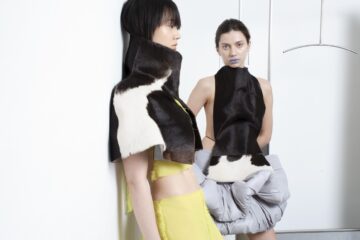
With Built to Belong, designer and stylist Elisabeth Kiko explores the idea of creating…



Maison Emilie Marcelle – On Couture, Comfort, and the Quiet Power of Women
In the quiet streets of Paris’ 7th arrondissement, Lisa Mimoun welcomes me in her atelier, an intimate space where garments are not simply presented, but examined, turned inside out, and understood. Last year, Mimoun had also opened a second pop-up location at the Sofitel at Place de la Concorde, yet the spirit of her work remains deliberately resistant to scale. Here, fashion unfolds at human pace.
Maison Emilie Marcelle evokes the vocabulary of Parisian couture with a distinctly contemporary awareness. Among only a limited number of brands, she has received the “Fabriqué à Paris” label, an ultimate commitment to craft and quality. The silhouettesof her pieces recall the clarity of the 1950s and 1960s – A-lines, architectural restraint, precision—yet the intention is unmistakably modern: clothing conceived to accompany women through real lives, real responsibilities, real power. These are garments that do not demand attention, but quietly reinforce presence. Elegance, in Mimoun’s world, is not decorative. It is structural, emotional, and deeply political in the most soft and beautiful way.
At the core of the maison lies a conviction rarely articulated so clearly today: that comfort is not the opposite of sophistication, and that female empowerment begins with respecting the body. Maison Emilie Marcelle is not about dressing women for an image, but for a life. In an industry still struggling to reconcile power with femininity, Lisa Mimoun proposes something quietly radical: clothing that respects the body, honours time, and reinforces the strength women already possess.
LISA MIMOUN: It truly began with a little black dress. At the time, I was working in the art world, traveling constantly – New York, Los Angeles, London, the Middle East. On one trip, I lost my luggage. I was away for two months, with professional obligations almost every evening: dinners, galas, exhibitions. And suddenly I realised that the one thing I needed most was missing: a little black dress. What shocked me was that, despite having access to beautiful stores and budgets, no one was really focusing on that essential piece. From 25 to 75, women often want the same thing in their suitcase: a few garments that can shift with context. You change your shoes, your jewellery, and you’re ready. So I decided to design those pieces myself – but with an absolute obsession for quality. For me, true luxury reveals itself when you turn a garment inside out. The lining, the construction, the finishing – this is where confidence is born. You feel it immediately. It changes how you stand, how you move. You stop thinking about your clothes, and that in itself is empowering.
LM: Completely. Empowerment doesn’t come from spectacle. It comes from how a garment supports you throughout the day. When something is properly cut, lined in silk, finished the way couture used to be finished, it gives you a sense of grounding. There is also something quietly sensual about that relationship between body and clothing. Not loud, not obvious. When you take the dress off, it is just as beautiful as when you wear it. That intimacy matters.
LM: Because quality and know-how cannot be rushed. When I decided to produce in France, I quickly realised that many ateliers could no longer execute this level of finishing—especially silk linings. It’s technically difficult. The fabric moves, it slides. I left everything else behind and committed fully. I met Nadia, who became my atelier partner, and we decided to work the way couture houses once did: one piece at a time. It’s more expensive, yes. But the world does not need more clothes. It needs fewer, better ones. Pieces that last, that can be transmitted. It took five years to train our small team to achieve this level of craftsmanship. But once know-how disappears, it is gone forever.
LM: Hubert de Givenchy dressing Audrey Hepburn is an obvious reference. I also love early Courrèges, Pierre Cardin. That clarity of line, those A-shapes – they flatter almost every body. They are chic, intelligent, and uncomplicated. One of our dresses is even named after Audrey Hepburn’s character in *Breakfast at Tiffany’s*. But it’s not nostalgia. It’s about translating that elegance into today’s reality.
LM: They are empowered women. They have careers, responsibilities, ambition. They don’t have hours to spend getting dressed. They move from meetings to dinners, from travel to events. They need clothes that don’t wrinkle, that feel good after a flight, that allow them to focus on their lives. Comfort is essential. I truly believe women are most beautiful when they are comfortable. Fashion has too often used the female body as an object, a surface for effect. That is not respectful – and it is not feminist. I try on every single piece myself. I move in it, I sit, I walk. If it doesn’t feel right, we change it. Clothes should accompany women, not restrict them.
LM: Of course. When you design for women but don’t wear the clothes yourself, something is missing. This is not about being against men – it’s about lived experience. You cannot fully understand what it means to inhabit a female body if you’ve never done so. There are incredible female pioneers – Elsa Schiaparelli, Sonia Rykiel – who understood that femininity and power are not opposites. Today, too often, women are told they must become more masculine to be taken seriously. That misunderstands power entirely.
LM: Female power is not about erasing softness. It is about owning it. You can be strong, ambitious, intellectual – and still deeply feminine. Equality alone is not an ambitious goal. Women bring something else into the world. A powerful wardrobe allows you to enter the world fully present. When you don’t have to think about how you look or whether you feel comfortable, your energy goes elsewhere – towards creation, leadership, change. I’ve had women cry in my atelier. They see themselves differently for the first time. Clothing can be therapeutic. It can truly change how you move through life.
LM: She was incredibly elegant. She had a room in her Paris apartment filled with clothes—a private archive. Sometimes she would take me inside and show me the linings, the lace, the finishing. She treated her garments like works of art. That sense of reverence stayed with me. Today, it is rare to feel that intimacy with clothing. I wanted to bring it back—to create pieces that are cherished, not consumed.
LM: Know-how is everything. Creativity and craftsmanship are what make us human. Once they disappear, they cannot be recreated – not even with unlimited money. Look at the sculptures in the Louvre. No one could make them today. Creating beauty is an act of resistance. Supporting artisans, preserving techniques – this is cultural work. And it matters deeply.
With Built to Belong, designer and stylist Elisabeth Kiko explores the idea of creating…
Numéro Berlin’s weekly collection of the most exciting news about fashion, music, and…

In conversation with Numéro Berlin, Conroy Chan and Iman Taheri discuss creative…