THE WHITE LOTUS, BUT MAKE IT MYKONOS
Four Seasons has arrived on the island, and somehow the most famous party destination in Greece has acquired a very calm, very polished, surprisingly family-friendly new address.
There are certain places in the world that have developed such a strong personality that you arrive already knowing what is supposed to happen to you.
Mykonos is one of them.
You come for the windmills, the blue water, the impossibly expensive beach clubs, the tiny white houses, the men in very small swimsuits and, depending on the season and your ability to recover, a vague sense that you may have lost 48 hours somewhere between Scorpios and a beach in Paraga.
For years, Mykonos has also been one of Europe’s great gay destinations a place where the summer comes with its own choreography, soundtrack and dress code. So naturally, when I heard that Four Seasons was opening its newest Greek property on the island, I imagined a certain kind of luxury. Champagne. Beautiful people. Something involving a very expensive cabana and at least one man called Alex who has been “between London and Ibiza” since 2018.
What I found instead was almost suspiciously peaceful.
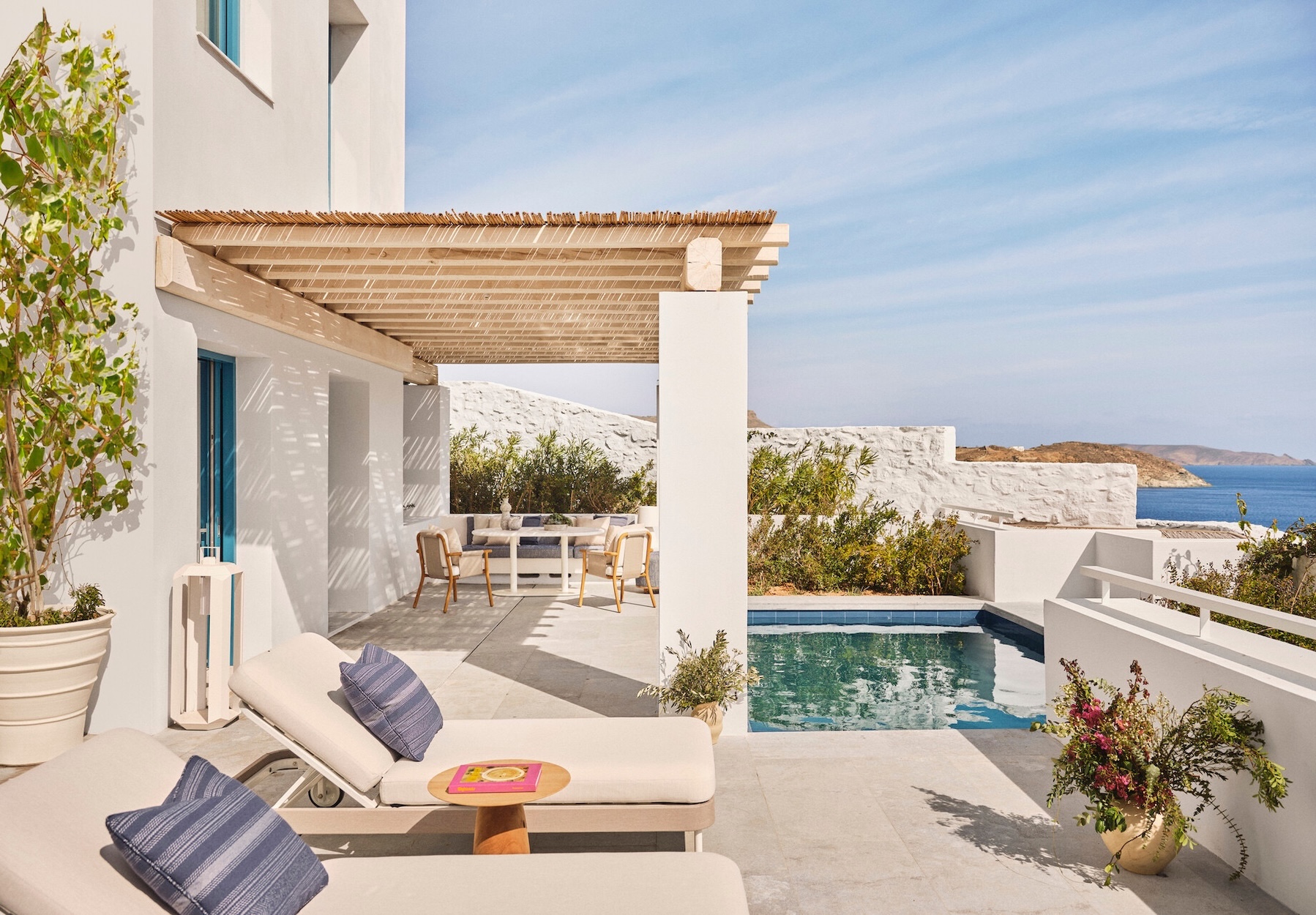
Four Seasons Hotel Mykonos opened in July 2026 above Kalo Livadi Bay, on the southeastern coast of the island. The resort stretches across six hectares of cliffside and coastline and has 94 sea-view accommodations, including rooms, suites and villas. It is around 20 minutes from both Mykonos airport and Chora, close enough to reach the island’s famous nightlife but far enough away that the loudest thing you are likely to hear in the morning is the Aegean.
This is, perhaps, the first joke. Four Seasons has arrived in Mykonos and appears to be encouraging people to sleep.

MYKONOS WITHOUT THE MORNING AFTER
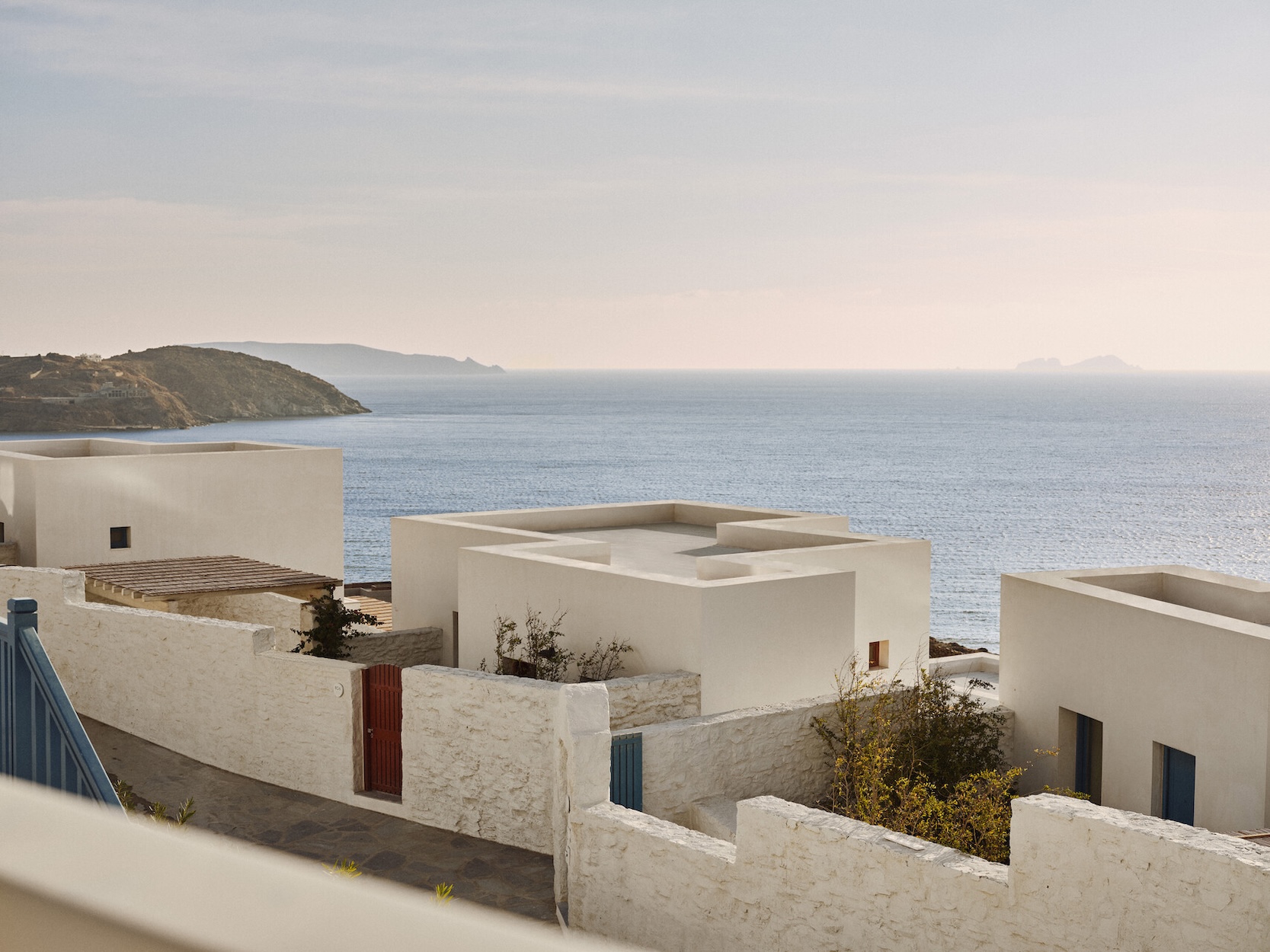
The hotel was designed by Greek architect Nicos Valsamakis as a contemporary interpretation of the traditional Mykonian village. Whitewashed cubic buildings climb the hillside, connected by paths, terraces and gardens, while Wimberly Interiors led the design of the guest rooms, suites, spa, public areas and kids’ club; landscape architect Helli Pangalou shaped the gardens. The result is less “new-build luxury resort” and more an extremely well-dressed version of the island itself.
Everything feels deliberately horizontal: the architecture, the view, the mood. There are two infinity pools, a private beach and a spa with six treatment rooms, sauna, steam room, vitality pool and an outdoor treatment pavilion. Food and beverage spaces were designed by New York’s Rockwell Group, with restaurants including ALEF, a Mediterranean grill; KAFENEO, inspired by the Greek coffee-house tradition; and CORBU, serving coastal Italian cuisine.
And then there are the families.
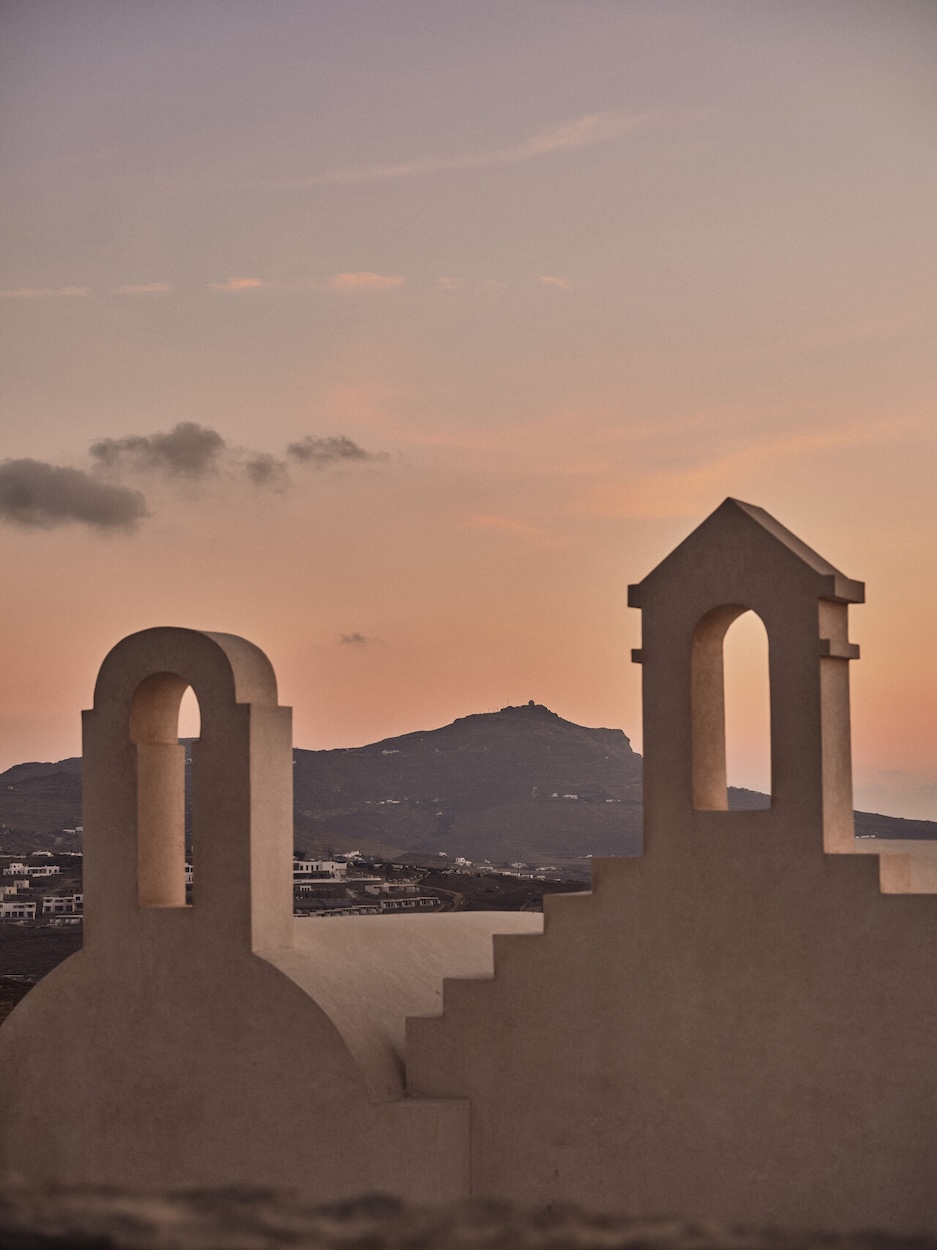
This is not something one traditionally associates with the more decadent version of Mykonos that exists in our collective imagination. Four Seasons has clearly decided that the island can accommodate children alongside the fashion editors, DJs, billionaires, queer couples and people who insist on ordering rosé before noon. The property offers family accommodations and a fully supervised kids’ club. There is also a chapel on site, which feels like either excellent planning or a premonition.
It is a different kind of Mykonos. Not less glamorous. Just significantly less interested in proving it.
ENTER THE WHITE LOTUS
There is another reason Four Seasons feels strangely familiar here.
Luxury hotels have become characters in their own right, and no television series understood this better than The White Lotus. The connection between the show and Four Seasons began in Hawaii, where the first season was filmed at Four Seasons Resort Maui at Wailea, and continued in Sicily, where the historic San Domenico Palace, A Four Seasons Hotel in Taormina, became the main setting for the second season. The third season moved again to Four Seasons Resort Koh Samui in Thailand.
The choice of San Domenico is especially revealing. Mike White and his team looked at a number of properties in France and Italy. White explained to Architectural Digest that many were too small to photograph well; when they arrived at the San Domenico, he said, “there was just something about it.” The converted convent “had a real vibe.”
That is probably the secret of The White Lotus: the hotel is never just a hotel. It has to look beautiful enough to make you want to book a room and strange enough to make you wonder what everyone is hiding in it.
Four Seasons keeps making sense for the show because it understands the fantasy it is selling. In Koh Samui, Mike White selected the resort for a story built around ultra-high-net-worth guests travelling in an ultra-luxury environment. In other words, the hotel already contains the social ecosystem his characters are designed to expose.
And Four Seasons Hotel Mykonos has that same visual contradiction: immaculate, discreet, expensive, serene — with the rest of the island’s chaos sitting just beyond the gates.
“These gays, they’re trying to murder me.”

THE QUESTION
Which brings me back to Mykonos.
There is a particular pleasure in arriving at one of the most famous queer holiday destinations in Europe and discovering that the Four Seasons experience is almost aggressively serene.
And that brings us, inevitably, to Tanya McQuoid. Jennifer Coolidge’s White Lotus character became one of television’s great accidental gay icons, and Season 2 gave us perhaps the most perfect line ever written for a woman discovering that the gay men around her may have sinister intentions: “These gays, they’re trying to murder me.”
The joke worked because The White Lotus understood something very particular about luxury travel: everyone arrives expecting the fantasy they have purchased to protect them. Tanya simply discovers that the fantasy has its own plot.
Mykonos, meanwhile, has spent decades creating its own version of that fantasy. There is a particular mythology around the island as a gay playground — somewhere the party goes on until your phone dies, your linen shirt becomes transparent and somebody you met yesterday is suddenly inviting you to dinner at a villa you have never heard of.

Except that at Four Seasons, the gays seem to be relaxing.
They are swimming. They are having lunch. They are getting massages. They are possibly reading.
PEPPA PIG IN MYKONOS
Then there is the other Tanya moment , the one that somehow captures the entire logic of The White Lotus in thirty seconds.
Tanya arrives in Sicily dressed entirely in pink, convinced she looks like Monica Vitti. Hotel manager Valentina looks at her and says the only thing that could possibly follow such a question: “Peppa Pig.” Tanya protests: “I’m Monica Vitti.” Valentina answers, “Monica Vitti’s dead, but yes.”
It is perhaps one of the great television jokes about fashion, aspiration and self-delusion. And it stays relevant in Mykonos because the island itself can sometimes feel like a giant exercise in self-invention. Everybody arrives as somebody else: richer, hotter, more relaxed, more mysterious, more desirable. A different person by sunset.
Four Seasons does something interesting with that fantasy. It doesn’t really fight it. It refines it.
You can spend the afternoon at the private beach or one of the two infinity pools, disappear into the spa, or take the short trip into Chora. The hotel is close enough to the island’s nightlife to make a spontaneous night out possible, but secluded enough to make the decision feel genuinely optional.
A TABLE WITH A VIEW
Of course, no Four Seasons story is complete without eating, and the dining here is less a collection of restaurants than a very well-organized argument for never leaving the property. All of the food-and-beverage spaces were designed by Rockwell Group in New York, and each has its own version of the Greek-summer fantasy.
Álef is the serious one: a Mediterranean grill built around premium meat cuts and fresh seafood, with Greek and Old World wines, candlelight and the Aegean as a backdrop. Kafenéo is softer and more local, inspired by the Greek coffee house and made for traditional meze, cocktails and the kind of conversation that makes you forget to check the time. Corbu takes the route to Italy, serving coastal cuisine with a little dolce vita energy by day before becoming a more intimate, candlelit dinner destination at night. And then there is The Beach, where handcrafted cocktails, light bites and the sea do most of the interior design. Together, they make a rather convincing case for staying in. Which, on an island famous for going out, feels almost subversive.
THE OTHER SIDE OF THE ISLAND
Perhaps that is what surprised me most.
Mykonos has spent decades perfecting its image as a place where everything happens. Four Seasons has opened a hotel that quietly suggests nothing has to happen at all.
You can go into town. You can spend the day at the beach. You can book a treatment. You can have dinner overlooking the Aegean. You can leave the property and enter the glamorous chaos of Mykonos, or you can stay exactly where you are and watch the light change over the water.
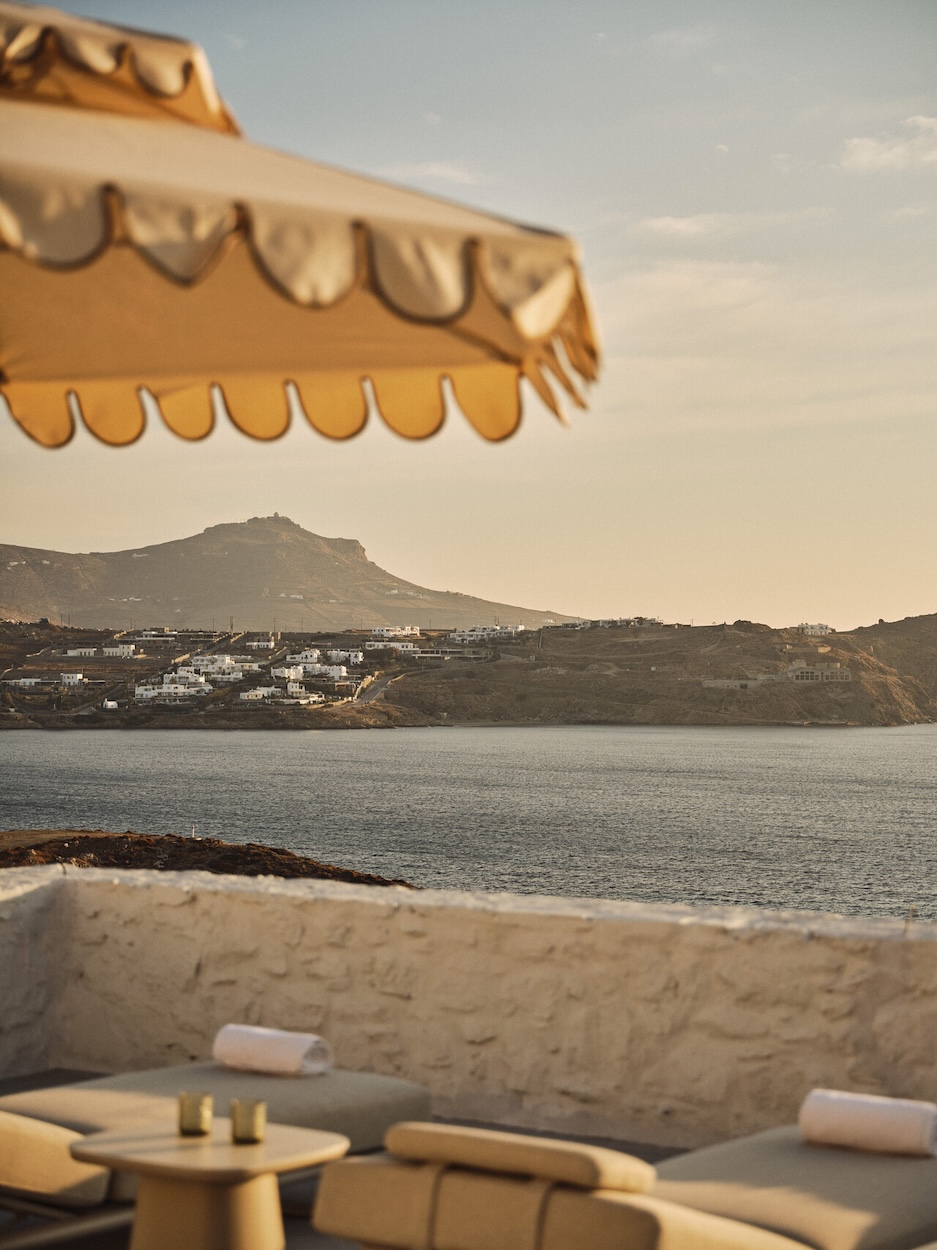
The hotel’s location makes the choice easy: it sits above Kalo Livadi Bay, on the southeastern coast, with the main town and airport around 20 minutes away. It is close enough to feel connected and far enough away to feel like an actual escape.
And perhaps this is the real luxury now.
Not being somewhere nobody else can reach. Being somewhere everyone knows — and still finding a little peace there.
Mykonos will continue to be Mykonos. The gays will continue to arrive. The beach clubs will continue to get louder, the sunglasses larger and the dinners later. Someone will inevitably wear a completely transparent shirt to lunch.
But above Kalo Livadi, Four Seasons offers another version of the island: slower, softer, more domestic, almost Mediterranean bourgeoisie in the best possible way.
A place where you can bring your children. A place where you can disappear for the afternoon. A place where the biggest drama might be whether you order another glass of wine at lunch.
And after The White Lotus, that may be the most radical fantasy of all.
Because sometimes the real holiday is not surviving the gays.
It is simply getting away from everyone.