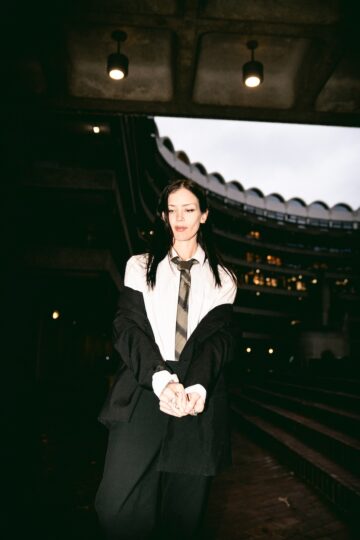
MUSIC PT. 82: RUTHLSS
As one of the featured artists on the new Houndstooth album Quantum Sound, Ruthlss brings…

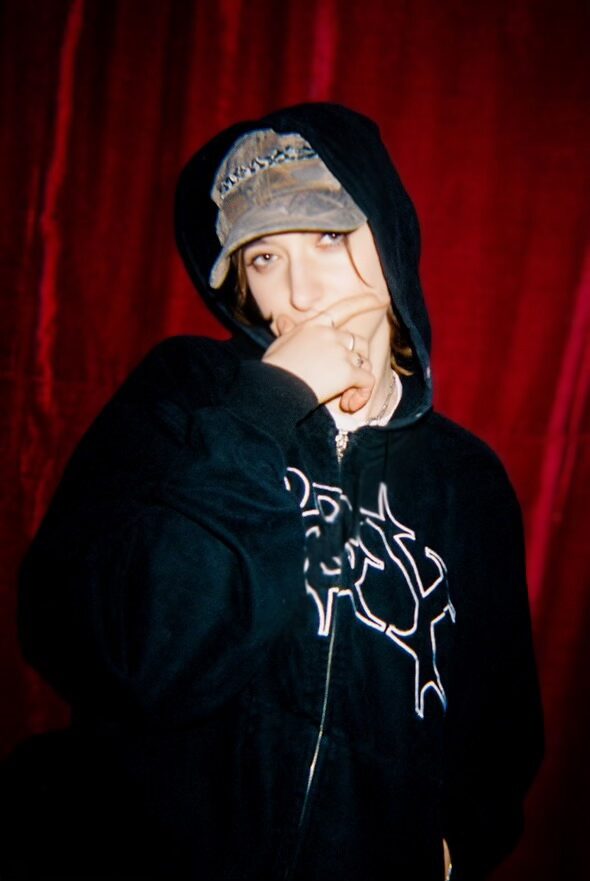
SERIOUS ABOUT MUSIC, NOT ABOUT HERSELF. MEET: MAARA
The artist Maara is originally from Montreal and has spent a significant part of her career living in Berlin, a city widely known as the techno capital. The nightlife is often defined by its industrial aesthetic and a very liberal atmosphere.
For Maara music is the central point of her life. She describes her drive as being almost entirely focused on creating music while other aspects of daily life often fall to the side. This dedicated approach has brought her to where she is today. She follows this path consistently guided by her own creative needs rather than commercial expectations.
Maara values being locked in the Studio and withdrawing to work intensely on new sounds. This level of focus allows her to dive deep into her projects. While she is incredibly focused, she believes that a sense of humor is key to staying creative.
With Ultra Villain she demonstrates that she does not limit herself to one specific genre but follows her own vision of electronic music. Even though she doesn’t consider herself a singer, every single vocal on this album is hers and –
we absolutely love what we’re hearing!
Maara: I’ve been making music for over a decade. I’ve been at it for quite a while, and I think it solidified pretty quickly when I started making dance music. That was in 2019. When I show my friends my music, they’re like, ‘Oh, it sounds like you.’ I think, because I can make different genres, the question for me personally is always: What is my sound? Even though to other people it’s recognizable. I think it’s certain stylistic things that are recognizably mine within the production realm; but however, I think because I don’t stick to one genre, I’m always thinking about what is my sound. So, to answer your question, I think there’s always been a through line with all my work. There’s always things that make it sound like mine, even when I think I’m doing something really different. People always tell me it still sounds like me, it sounds like Maara.
M: I felt more free to explore different sounds and more uninhibited in terms of what I was doing. I guess we’ll see how that holds up over time. You know, as things evolve and as people grow, the newness of the project Maara will fade over time, and maybe I’ll want to explore different aliases and start different projects to do a different sound. But there’s no classic alter ego for it. I’ve played around with ideas, and I’m doing a minimal dance project. And when I still put it out under Maara, I feel like it’s going to sound so different. But then again, when I show people this music, maybe they’re still going to be like, ‘It sounds like you.’ But maybe just to conceptualize the approach differently, it would help psychologically having the option to change my artist name again there. But we’ll see what happens.
M: I think the crowd needs to be there and needs to be with it. When I play for crowds where there’s that energy and receptiveness, and I sense an open-mindedness to what I play, people who just want to party and have fun, that’s the crowd for me. If it’s in a club, I really like playing in a dark room with not too much light on me. That allows me to feel immersed, and it feels like it’s more about the dance and less about the DJ booth.
I’m just playing music for people, I don’t wanna be stared at the whole time.
M: I’m a freestyler, so yes and no. Yes, to an extent. Especially with a longer set, I want to pace myself and play things I don’t normally get to play. I play with a lot more patience, and I’m not just going to play high-energy bangers the whole time. I want people to wait for it a bit and let me work my way into it. And when I feel like the crowd has that patience and receptiveness, I can do it. But then there are other times when I don’t feel that at all, and I just have to start playing bangers and then figure it out from there, how to rebalance the energy.
M: It really depends a lot on the party and the overall vibe. I think that in North America there is, at least right now, a different sound going on. Some clubs I play at are really special and amazing and I just don’t think I could get that in Europe. But then some European gigs have been really fun and lit and I probably wouldn’t get the same energy in North America. I guess whether I can really do me or express myself comes down to the party and the crowd.
M: Yeah, I would have to say New York City. It is consistently good, the crowd is really committed and there for it. I have only played there a couple of times now and even the ones where I did not feel like I played that well, I still felt that energy there. It felt special and it has just always been consistent.
M: I try to stay as focused as possible and I would say I am a little bit more in my logical brain. I keep a bit of a thought process behind it and I like to treat it like work because I want to do a good job. But some parties are so fun to play that the boundary becomes a bit more blurred and I get to really enjoy myself and have fun with it.
Sometimes when you’re DJing all of a sudden it starts to flow, and you’re like, I can make no mistake right now.
The crowd is so there for it that it doesn’t even matter what I play next, it’s gonna be really good. Other times it’s not like that at all.
M: Yes, definitely. Because you enter into this circuit of producing and DJing, and you get recognition for it. Then there is this pressure to continue, especially in the context of the capitalist world we live in. Give the people what they want, which in my case is a lot of dance music. But I try to balance that with my ethical and authentic drives and desires because at the end of the day, I truly make music for myself. I make stuff because making music is like a sonic journal for me.
It’s important for my mental health to be creating things and it’s what I want to do with my life regardless.
I just really enjoy the process. I have a wide range of sounds and stuff I want to do. And even with my album coming out, it’s not really dance music per se, but I’m associated with dance music. But I’m always going to do what I want.
M: Yeah, I like it to an extent because it keeps me focused and locked in. I feel like I always have to be working towards something or working on something. I have a fear of not actualizing my full potential or dying and feeling like I could have done more. I never want to get complacent with anything either.
I’m really grateful for my life right now. I’ve worked really hard to get here and I never wanna take that for granted.
M: I try to depersonalize things as much as possible. Divesting some of your ego from it is a really good thing because the worst is when you are thinking, ‘Oh, it could have been better,’ or ‘Maybe the crowd did not like what I played.’ It is about having confidence in yourself and thinking, ‘I am here for a reason.’ I am doing this for a reason, and there are going to be really good gigs and then there are going to be not so good gigs, and it is all fine. I am never going to feel well rested. I am never going to feel in the mood for it anyway. But I think at the end of the day, I really try to just adapt for a second. I will sleep when I sleep. I will be okay. Being tired is not the end of the world. I used to get anxious before playing when I was really tired and felt like shit. But now I try to really be like Buddha about it.
M: I kind of do both. When I was starting out, I definitely had model tracks. I would try to emulate things, but I feel like I would always end up somewhere else. I started off wanting to do one thing, but it ended up being something different, which is also nice. Currently, it is a bit more intuitive. I just start. I am trying to find new inspiration and make the dance music I want to make. I want to sonically explore the next few sounds I want to cover in my production. But I guess there is a bit of pre planning of sorts.
M: I made it over a span of time. I think the earliest track on there is actually from 2021, followed by others from 2022 and 2023. Those are some of the earlier ones, while many of the others are more recent. It depends on the specific song. With some of them, I was very heartbroken, distraught, and anxious. I was dealing with a lot of things. Other songs were more about longing and lust, and how people relate to themselves.
M: Definitely. I think some of the songs were a collaborative effort between me, Francis, and Patrick Hollins in Montreal. Originally there was a one minute loop on my computer with just a very rough vocal idea and we went back to that song. They read the chords of the sample, sampled it and then we really scratched it out into a full song. And with the vocal stuff Pat really pushed me to hit the right notes. I am not really a singer, I am just making vocal music and writing songs. So it was really interesting to be privy to that process. To really go back to the tracks on the album and dive deep and do the extra 10 percent on it. I think that has made a difference and I am proud of it. It is hard sometimes and at the same time, it is like whatever. I made the songs because they felt cathartic and important for me to write. I am not thinking too deeply about it.
M: I mean, the obvious answer for me would be the people in my life, the relationships I have inspire me a lot. My friends, the dynamics I have with certain friends. Yeah, just having a sense of humor about things and making myself laugh about stuff is very important to my process and not taking everything so seriously.
M:I mean, it’s all been a surprising sequence of events to some degree. You know, I wasn’t really expecting fully doing music. But in a way, I also never even thought about it. I was just like, next thing, next, next. And I think I’ve always kind of moved through life like that, especially with music. I’ve just always stuck to this drive and being like, ‘Who even gives a shit, I just want to make music’ kind of got me where I am. Because all I’m focused on is making music and everything else falls to the side. I’m very disorganized about everything else. So, I guess something I wouldn’t have expected is still having this apartment and not changing any of the furniture. Or that I feel really happy, I don’t think I would have imagined that.
M: On a creative level, collaborating with other people.
M: My dream collaboration would be Kelela, that would be sick! And then I am working with Maricas and Context on two different EPs. It is a music label, and I think, just finding time to create and rebalance myself out in terms of my inspiration right now, just having a creative reset. Just continuing to make music and be good about planning things. And what was the other question about DJing?
M: Yeah, I think just applying myself. You know, prepping and taking the time to dig and really putting effort and struggle into everything from wanting to write music on the weekdays to digging in and then getting ready for the gigs. If I am really deep in a project, sometimes I will be producing up until the gig. And then, I want to be more locked in. You know, every gig I play one different song or, you know, I find one song a week or something similar for sure. That would maybe be, yeah, just strengthening me as a DJ.
M: A bit of both. I have gone back and forth between wanting to chill for a second and thinking, ‘Okay, what is next?’ I want to be locked in the studio whenever I can. But I am going to Sao Paulo now, and then I am going to Rio after playing a show there. I should just embrace it and relax.
M: Thank you!
As one of the featured artists on the new Houndstooth album Quantum Sound, Ruthlss brings…

Labrinth on inner demons, the music industry, and why he regularly has full-on…
Sovereignty in sound: Joji's new album PISS IN THE WIND