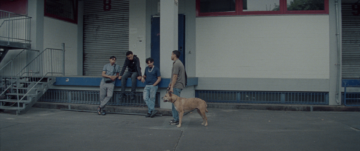
TO WATCH “THE LIGHTS, THEY FALL“ BY SAŠA VAJDA
Amidst the millions of lives unfolding daily in Berlin, a particularly painful one unfolds…



„RAUS AUS DEN TOILETTEN, REIN IN DIE STRAßEN“
For this week’s film tip, we would like to recommend a new exhibition on movies rather than one specific film, simply because it is quite remarkable in its execution.
„Inventing Queer Cinema“ is an exhibition and film programme running at the Deutsche Kinemathek in Berlin until 13 September 2026.
As the name suggests, the exhibition explores queer cinema in all its aspects – from its very beginnings and key figures to its role in today’s cinematic landscape. Importantly, the Deutsche Kinemathek does not claim completeness in presenting queer cinema and its invention. Instead, it emphasises that this history should be understood as an ongoing process that continues to evolve today. The exhibition takes place in the vast halls of a former electrical substation and includes a textile archive featuring original costume pieces such as Marlene Dietrich’s iconic top hat and cigarette case. Special tribute is paid to Manfred Salzgeber, a film distributor who spent a lifetime advocating for queer rights and bringing queer stories to cinema screens across Germany and beyond.
A timeline documents and highlights key moments in the evolution of queer cinema history: from the world’s first explicit homosexual film, „Anders als die Andern“ by Richard Oswald in 1919, to the first lesbian kiss in a Hollywood film in „Morocco“ (1930), and the AIDS epidemic of the 1980s. Films such as Westler and Zimmer 303 demonstrate cinematically how deeply the epidemic affected the gay community.
Paragraph 175, which criminalised homosexual acts, was only abolished in 1994 (!), followed 22 years later by the first Academy Award for a queer film, „Moonlight“.
The timeline concludes with studies indicating a decline in LGBTQ representation in US films due to a political backlash against diversity in 2025/26.
Three huge screens positioned side by side show excerpts from a wide range of films connected to queer history, creating an all-encompassing experience. Combined with hanging posters, information boards, quotations and portraits suspended from the ceiling, the exhibition’s curation conveys queer cinema’s quiet omnipresence. Once inside, you do not know where to look or what to read first, and slowly realise just how much there is – and has always been – just beyond the boundaries of mainstream attention.
„Inventing Queer Cinema“ successfully highlights the hopes, struggles and achievements of actors, film distributors and directors such as Chussein Erkenow, who personally smuggled his film „100 Tage, Genosse Soldat“ by train from Moscow to Germany after it had been strictly banned in Russia.
The exhibition impressively showcases the resilience of queer figures, while also revealing the beauty that can emerge from pain and hardship, leading to such special movies.
The Deutsche Kinemathek also has a studio cinema at its disposal, screening a variety of queer films daily as part of the exhibition.
The weekly corresponding programme can be found here.
Amidst the millions of lives unfolding daily in Berlin, a particularly painful one unfolds…

Saying „This is what I love about you“ to someone, and a computer responds? Florian…

“Everytime” relentlessly zooms in on what it means to deal with the hole left behind…