
IN CONVERSATION WITH ADRIANO SACK
Adriano Sack’s "In die Sonne fliegen" explores the glamour, ambition and darker sides of…



WHAT WILL THEY THINK OF US?
Italy, summer, ice cream. The sea, the heat, a family holiday. Seven-year-old Ela (Elise Lindner) sits beside her mother Cornelia (Rosalie Thomass), watching her laugh freely while speaking Italian as ice cream melts in the sun. These moments feel weightless. When the family returns to their provincial town in West Germany in the 1980s, that warmth disappears. Werner (Golo Euler) has decided what is wrong with his life: his stalled career, his lack of social standing, even the way the family is perceived by their neighbors. And for him, the explanation is always Cornelia’s body.
What follows is a slow tightening of the space around her. Werner monitors what Cornelia eats, excludes her from social occasions and resists her attempts to return to work. When her inheritance allows the family to build the house he wants, it brings him the status he has been chasing, but Cornelia remains financially dependent and increasingly isolated. Ela watches all of this unfold, initially absorbing her father’s perception of her mother before gradually learning to distinguish it from the woman she actually knows.
Director Aron Lehmann makes Ela’s perspective the film’s defining element. The camera frequently stays at her height, looking up at adults whose conversations and decisions remain only partly comprehensible to her. Rather than explaining what Ela feels, the film lets her uncertainty shape what we see. Ela occasionally returns as a narrator, breaking the fourth wall, looking back on moments her younger self could not yet understand. The effect creates a quiet distance between memory and experience, allowing the audience to discover the family dynamic alongside her.
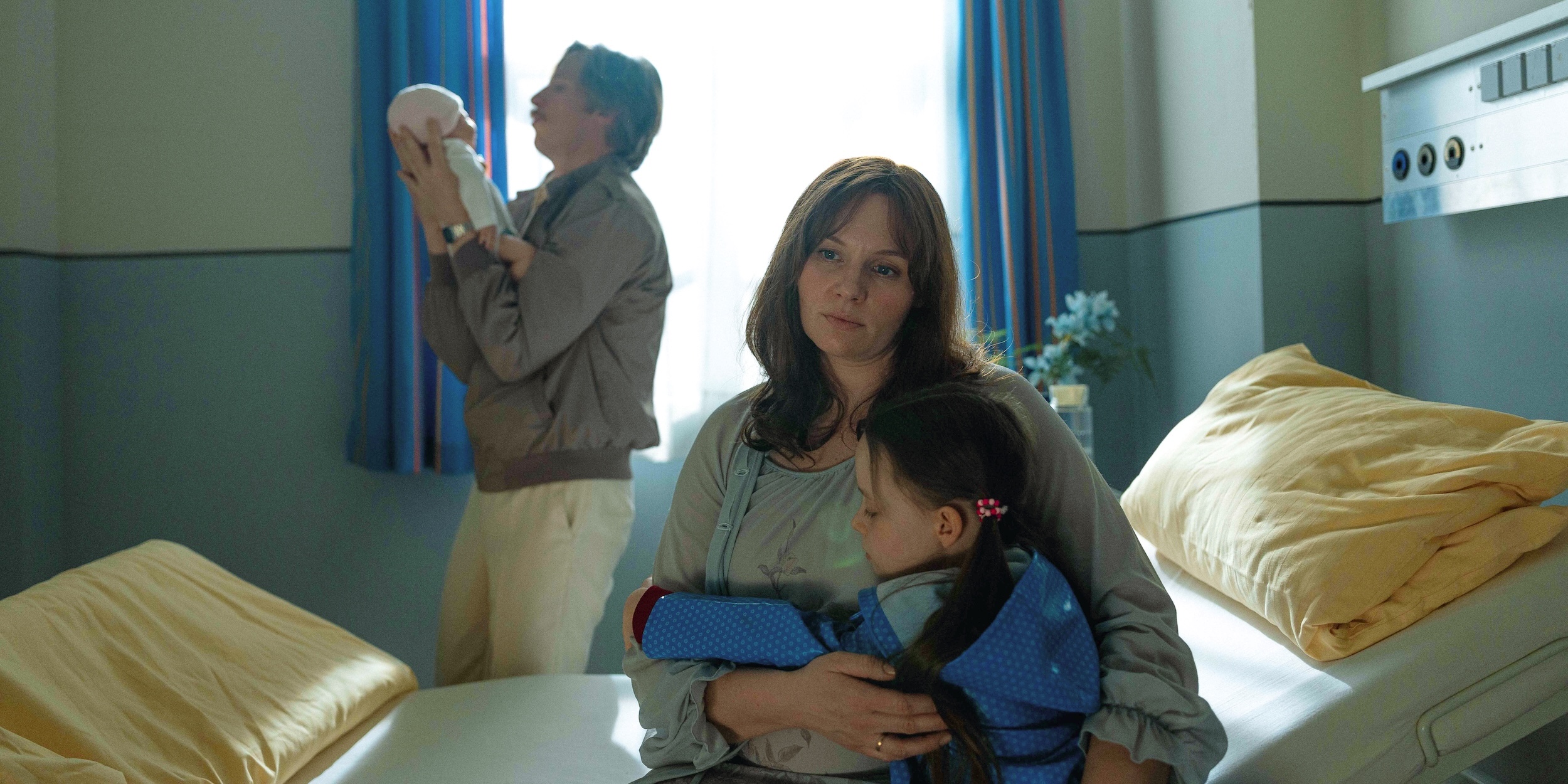
The visual language reinforces that childlike disorientation without turning it into a gimmick. In one striking sequence, Cornelia lies collapsed on the floor and sends Ela away to eat, with the image suddenly turning upside down as Ela moves through the room. It is one of the rare moments in which the film briefly shifts away from Ela’s usual vantage point, making the physical world feel as unstable as the one she is trying to understand. Lehmann trusts the perspective of a child who sees and absorbs far more than she can articulate.
The performances make that perspective particularly affecting. Rosalie Thomass gives Cornelia warmth and vitality alongside the gradual exhaustion of a woman constantly being told to make herself smaller. Golo Euler plays Werner with an unsettling mixture of self-pity, insecurity and resentment, while Juliane Köhler brings a sharpness to Martha, Cornelia’s mother in law, whose complicity reinforces the pressure on Cornelia. Elise Lindner (Ela), meanwhile, carries the film’s emotional centre with remarkable restraint, capturing a child caught between what her parents tell her and what she instinctively understands.
Based on Daniela Dröscher’s bestselling novel, “Lügen über meine Mutter” is ultimately less interested in explaining its characters than in showing how a child learns to make sense of them. What begins as Ela’s attempt to understand why her father sees her mother the way he does becomes a quieter story about perception, memory and the things children understand long before they have the words for them. “Lügen über meine Mutter” hits German cinemas on October 8.
Adriano Sack’s "In die Sonne fliegen" explores the glamour, ambition and darker sides of…

Neuswanstein brings together indie rock, hip-hop and electronic production in a sound…
As Silencio celebrates 15 years in Paris, founder Arnaud Frisch brings the club’s blend…