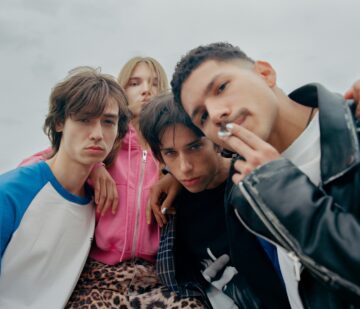
DAGGER “Meet the Cast”
What does it mean to leave a place behind when so much of who you are remains tied to it?…


A GROOVY KIND OF FAIRYTALE
Somewhere between hypnotic grooves and dreamy melodies, MOLASS create a sound world of their own, which they describe as a “Groovy Fairytale”. At its centre is vocalist Marissa Möller, who reflects on the connection between her personal life and creative practice, exploring self-doubt, dreams and finding her artistic voice. MOLASS are currently on tour, playing at Berlin’s Badehaus on 30 November 2026.
Marissa Möller: Being able to give abstract feelings a tangible form through music is what makes it so meaningful to me. Sometimes, I don’t fully understand my emotions. I’m left with a vague, undefined feeling, and being able to express it through music just means everything to me.
I find singing is also incredibly fulfilling, both physically and mentally. It’s almost like meditation. I started writing my own lyrics relatively late. Having worked in musical theatre, where you’re given the repertoire you’re expected to sing, I always felt something was missing. That frustration eventually led me to start writing, and I’m so glad I did.
MM: I find it really difficult to say when you’re truly being yourself. I think you automatically play a role or adapt to your surroundings to some extent. But I’m still trying to find my personality on stage as a musician.
MM: The process is different every time. Sometimes Jan, my partner and the band’s pianist, comes up with an instrumental idea, and I write the melody and lyrics. Other times, I start by writing freely, almost like a diary, until a central theme emerges. I usually write lyrics before the melody, though I’ve recently been experimenting with the opposite. Either way, Jan and I always work together.
“Being able to give abstract feelings a tangible form through music is what makes it so meaningful to me.”
MM: Yes, absolutely. In those moments, I try to keep going. I tell myself: “Just do it anyway. Trust whatever comes out naturally. And if it’s not good, so what?” I’ve realised there’s always something to write about. I just have to let go of the pressure to make everything good and allow myself to get into a creative flow.
MM: Where do I even begin? I really struggle with feeling like I’ll never be good enough. Sometimes it completely overwhelms me. I spend a lot of time trying to understand these feelings rather than pushing them away. I want to figure out where they come from. Some of our songs explore these feelings, which makes them very personal to me.
MM: I’d tell my younger self to pursue her goals sooner, take action and not let fear hold her back. It hurts a little to look back and realise how much it held me back. At the same time, I’d tell her to relax and enjoy what she does without putting so much pressure on herself. I’ve always moved forward in my own way. Maybe I needed the time to find my path. Things might be different today, but that doesn’t mean they would be better.
“I’ve always moved forward in my own way. Maybe I needed the time to find my path.”
MM: Definitely, we’re now playing at renowned jazz festivals, which is something I never would have imagined. Ten years ago, I used to look up to the musicians performing at these festivals. And now I’m playing on those very same stages with my own musical project. That feeling makes me really proud.
MM: I think it’s actually “Toto.” It captures how I often feel after coming off stage, when I start questioning myself and thinking I’ve done terribly. The song is about not letting that negativity take over, that nagging feeling that what I do somehow isn’t enough. I think the music captures that feeling quite well. Fortunately, I experience that feeling less and less often. I feel like I’m slowly getting better at dealing with it.
MM: We were definitely influenced by Hiatus Kaiyote, the Australian neo-soul band. But I don’t really think about fitting our music into a particular genre. Our sound draws on neo-soul, jazz and fusion, but it’s not easy to pin down. I want to bring together anything that genuinely moves me. I listen to a lot of music from the sixties, seventies and eighties, and those influences naturally find their way into our sound.
Writing a song is always an experiment. I might start with an idea, Jan adds his own, and gradually something takes shape. We like to move away from conventional song structures and let each song find its own shape. I’m not trying to be deliberately different; it simply comes down to what feels right in the moment.
“I want to bring together anything that genuinely moves me.”
MM: Sometimes, yes, sometimes, no. The creative process is unpredictable and requires a lot of patience, which I’ve always found difficult. It’s a bit like painting: in the beginning, it rarely looks like much. I have to learn to trust the process rather than panic when things aren’t coming together yet.
MM: I actually have a very specific image in mind: a clearing with a single tree, the sun setting, the sky turning pink and a gentle breeze rustling through the leaves. It’s a place of complete peace. I’ve actually dreamed about this place several times. It also appears in some of our songs, including “Plumape Cake” and an unreleased track called “Can You Come With Me?”
Can You Come With Me?” deals with the state of society today and the feelings of helplessness and abandonment it can bring. Sometimes I wonder where to go when I feel left behind. That’s when I return to this place in my mind and ask someone to come there with me. And that person is Jan.
MM: Definitely. Dreams can feel so intense that their emotional impact stays with you throughout the day. Sometimes you can’t even remember what you dreamed about, yet you sense that something has shifted. I’m particularly drawn to writing about things I have a personal connection to. That’s what gets my creativity flowing and allows me to find my way into a song.
MM: Everything I experience finds its way into my music in one way or another. Writing songs allows me to process what’s happening in my life, understand myself better and grow as a person. In that sense, making music is an ongoing journey of self-discovery.
What does it mean to leave a place behind when so much of who you are remains tied to it?…
Numéro Berlin’s weekly collection of the most exciting news about fashion, music, and…
Braths builds musical bridges between two genres that seem as opposing as they can get:…