
JANINE GROSCHE: THE SHAPE OF LATEX
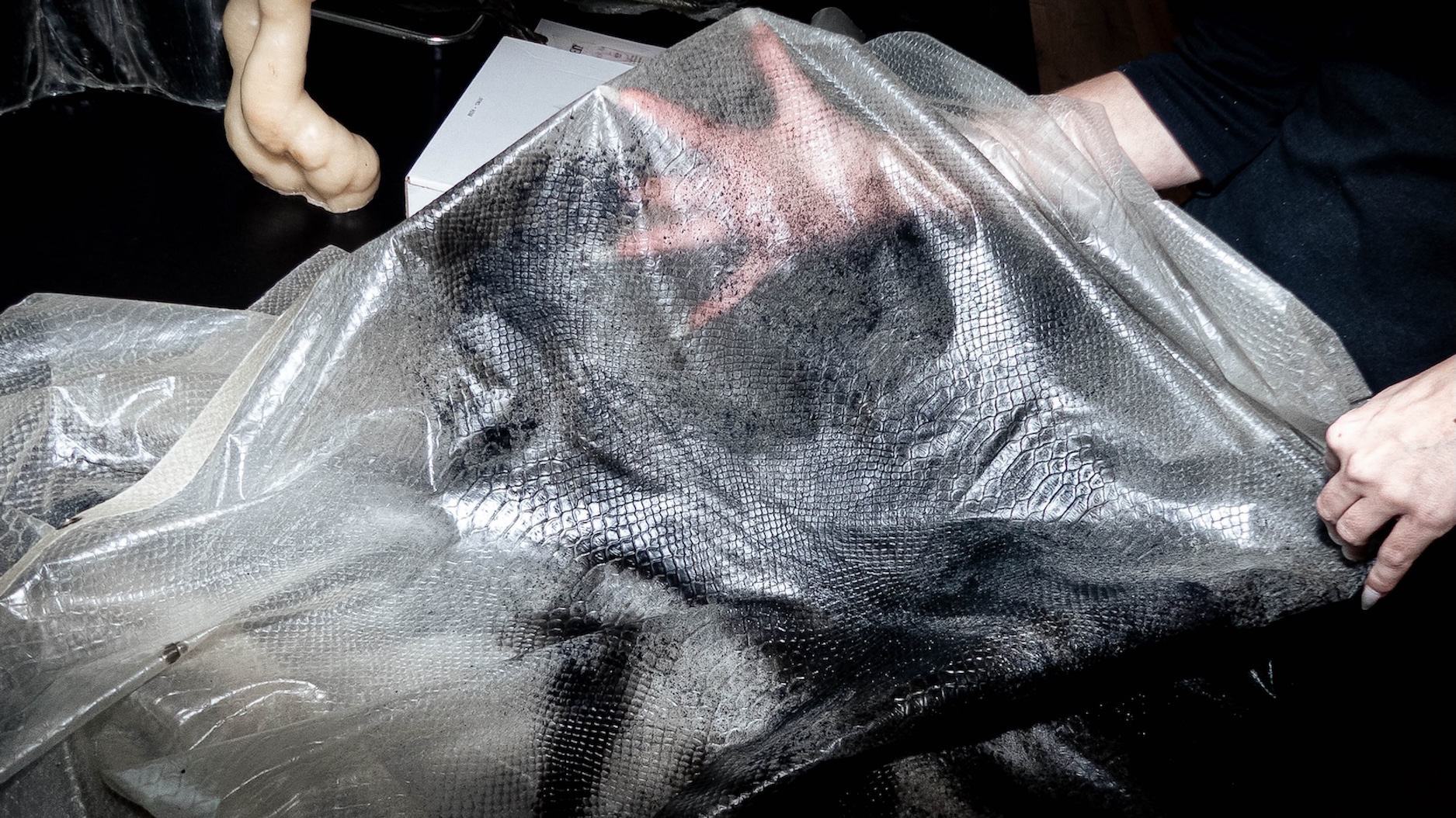
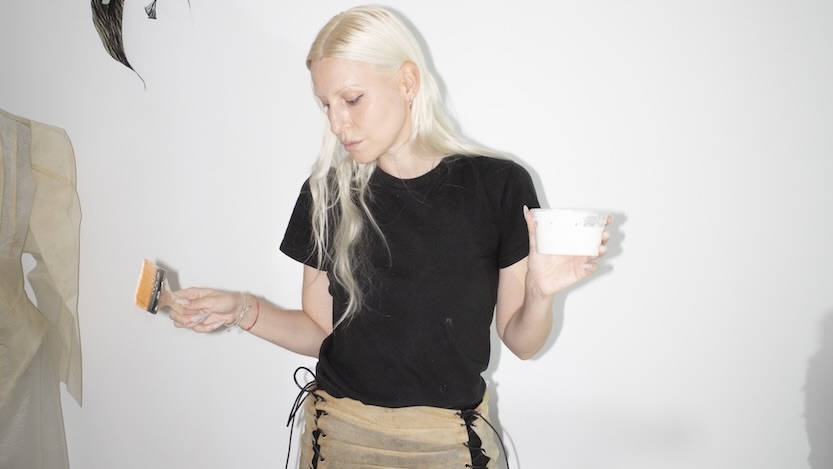
Sitting in her daylight-flooded atelier, Janine Grosche tells us about her work with latex, her experimental approach and the journey that led her to go beyond the boundaries of clothing. Through PATH, her artistic practice, she transforms liquid latex into translucent, skin-like forms. With these, she creates fashion, sculptures and objects. In conversation with us, Janine Grosche reflects on the ideas, experiments and challenges that have shaped her practice and lets us capture insights into her workspace and creations.
“I actually find it really interesting when you can’t clearly define something, when it exists somewhere in between.”
Elin Luehmann: When did you start working with latex in the way you do today?
Janine Grosche: I started experimenting with liquid latex about three years ago, in 2023. I actually have a much longer background in fashion, so I already had a good understanding of pattern cutting, construction, fit and working with different materials. But starting with liquid latex was incredibly exciting because suddenly I could develop my own material rather than work with something that already existed. What began as an experiment has evolved into years of material research, and I’m still constantly discovering new possibilities.
EL: Would you still call yourself a fashion designer, or does that term feel too restrictive for the work you do now?
JG: I find the term a little too restrictive because it doesn’t really represent everything I’m doing now. I think I sit in several categories at once. Fashion is still an aspect of my work, but so are sculpture, material research and textile art. My work also moves between performance and installation.
OMEN, for example, is no longer a collection in the traditional sense. It’s an ongoing body of work that isn’t tied to seasons or conventional fashion cycles. It keeps evolving and taking on different forms. And I think that’s really what PATH has become, my creative practice encompassing all these different aspects. It’s all one interconnected world.
There’s always this need to define exactly what something is, to put it into a category. But I actually find it really interesting when you can’t clearly define something, when it exists somewhere in between.
EL: How did you start working with Latex? Did you begin by making patterns?
JG: In the beginning, to be honest, it had nothing to do with fashion. That wasn’t my intention at all. I was experimenting with the material, creating variable pieces or sculptures. I had already worked a lot with wax, and I think that’s where my love for materials came from, as well as my interest in working three-dimensionally rather than just with flat surfaces or patterns.
Then I stumbled upon latex in Beijing, where I saw a huge exhibition by Heidi Bucher, an artist who had worked with latex in the 1970s and 1980s. I was so inspired that I thought I had to try latex myself and experiment with it. Initially, I wanted to incorporate wax into the latex, but the wax gradually disappeared while the latex remained. Through experimenting, I discovered that I could capture surfaces.
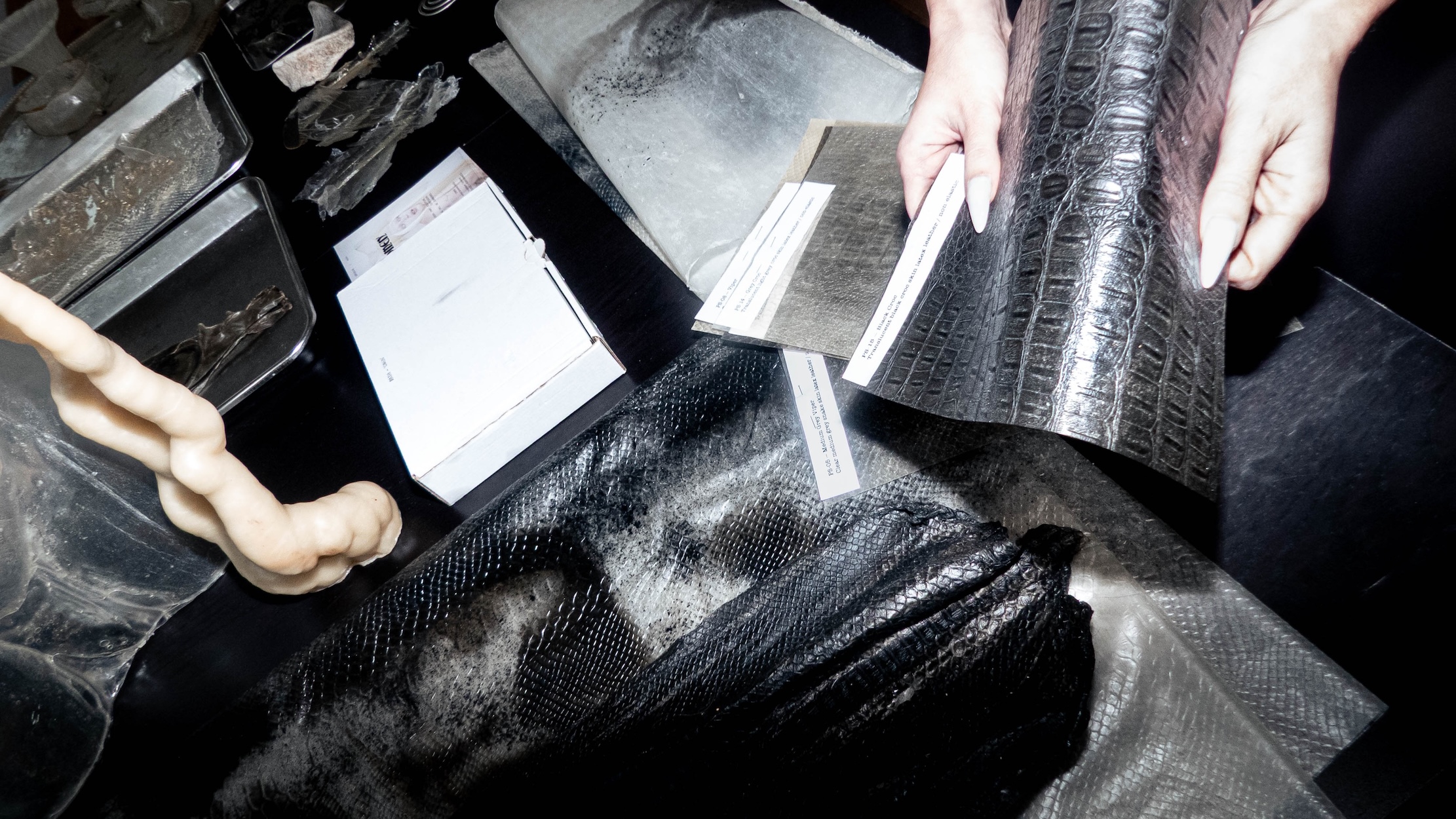
I then started working with snake and crocodile skin imprints. I realized how interesting it was to create these textures in a transparent material, almost like a second skin. It was a discovery rather than something I had been looking for. The process gradually became more serious, and before leaving Beijing, I felt I had to do something with it. So I made a few pieces—not really a collection, just a dress and a coat. We photographed them in Hong Kong just three days before leaving. I really wanted to take something with me that I could continue to build on.
EL: You spent 15 years working in fashion, particularly in menswear. What led you to move away from conventional clothing production and explore a more sculptural approach to your work, ultimately opening up a new path for you as an artist?
JG: What I enjoy most is the experimental process, particularly working with a material like natural liquid latex. It starts as a liquid extracted from trees, and through different processes, I can transform it into these incredibly thin, translucent skins. When I first began developing my reptile-like surfaces, I hadn’t encountered latex being used in quite this way, and I became fascinated by the possibilities.
Over the past few years, I’ve developed my own techniques and visual language, constantly testing the material’s limitations and pushing it beyond what I initially thought was possible. There is still so much I want to explore.
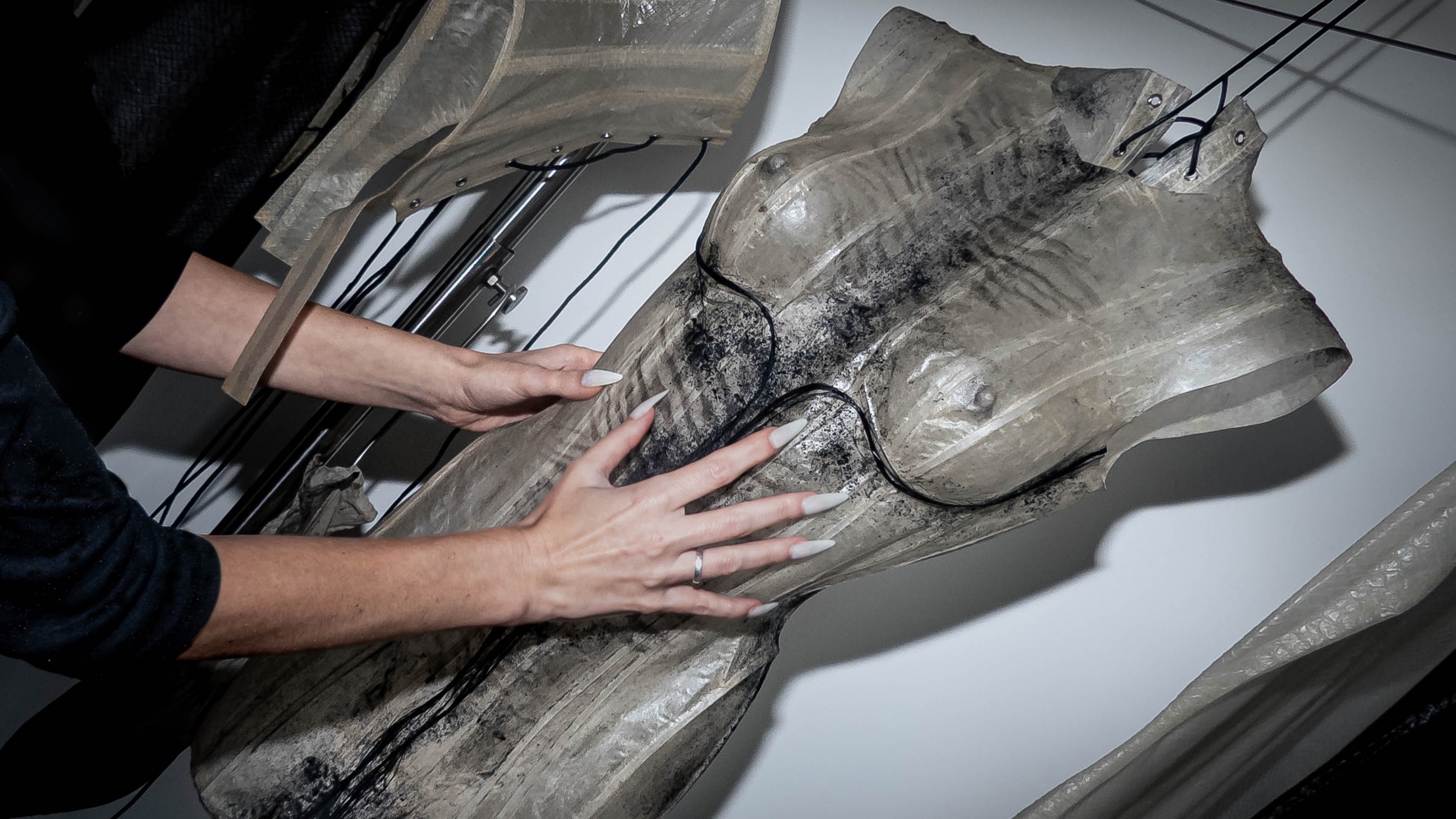
I think the shift towards a more sculptural practice happened quite naturally. At some point, the works no longer needed to function purely as garments. They could exist independently of the body, somewhere between clothing, sculpture and artefact. And I find that freedom incredibly exciting.
“It’s almost as if the garment becomes a separate entity, responding to the body and movement in its own way.”
EL: Your work—both the clothing and the objects—often relates to ritual objects and mythology. What fascinates you about these themes?
JG: I’m really fascinated by the uncanny, the mysterious, the spirit world, folklore and old tales. I love the atmosphere all of this creates, the energy. You know, when you sit around a campfire and somebody tells an eerie story, it’s not necessarily about the story itself, but more about that strange feeling it leaves behind, almost as if something has been awakened. And I think that’s also what draws me to ritual objects. They carry a certain presence, something familiar but also unsettling. That’s a feeling I’m interested in creating through my own work.
EL: Artists such as FKA Twigs and COBRAH have worn your pieces. Their bodies are central to their artistic language. What happens to a garment when it leaves your studio and begins to move, perform, and exist on another body?
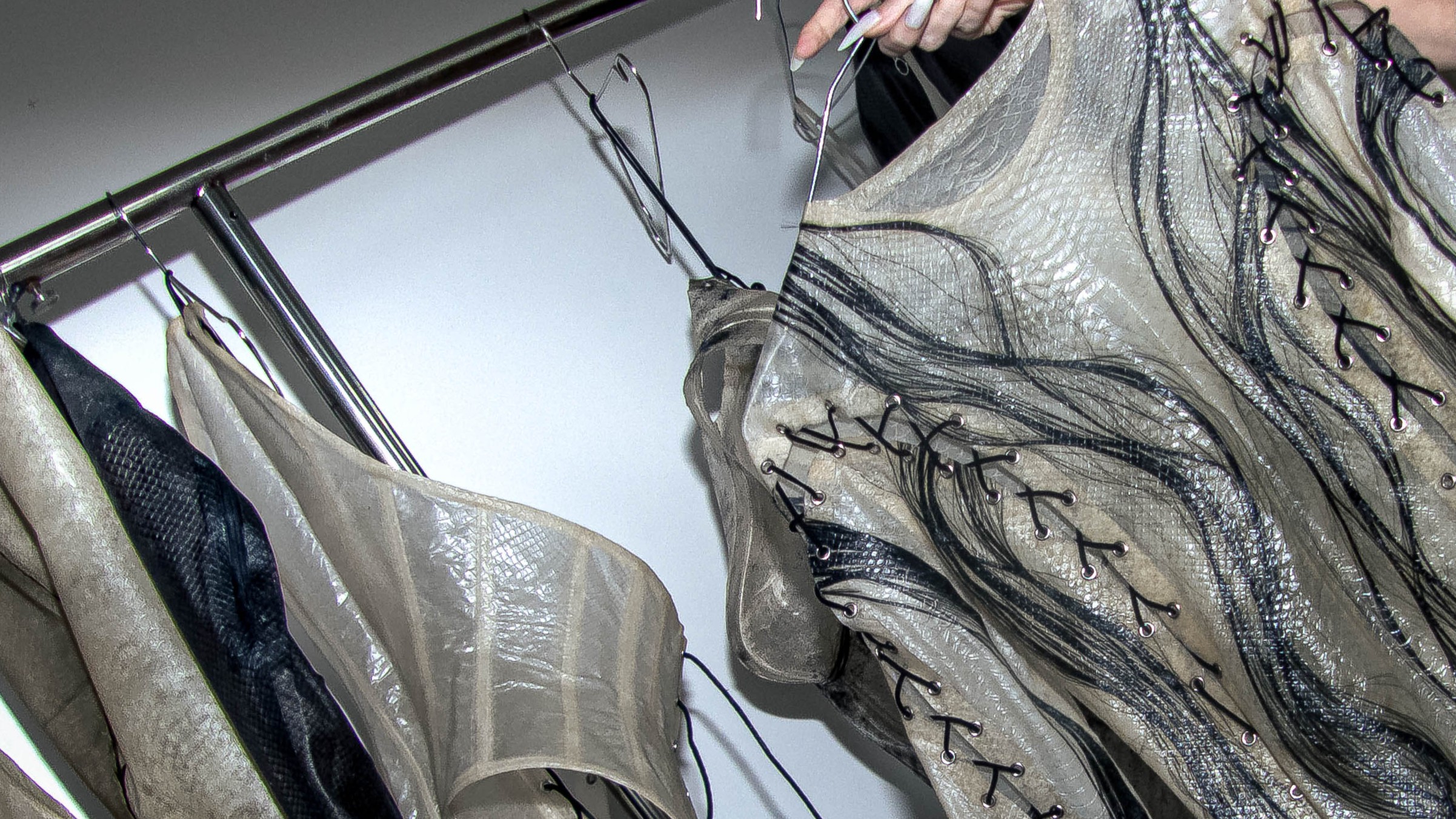
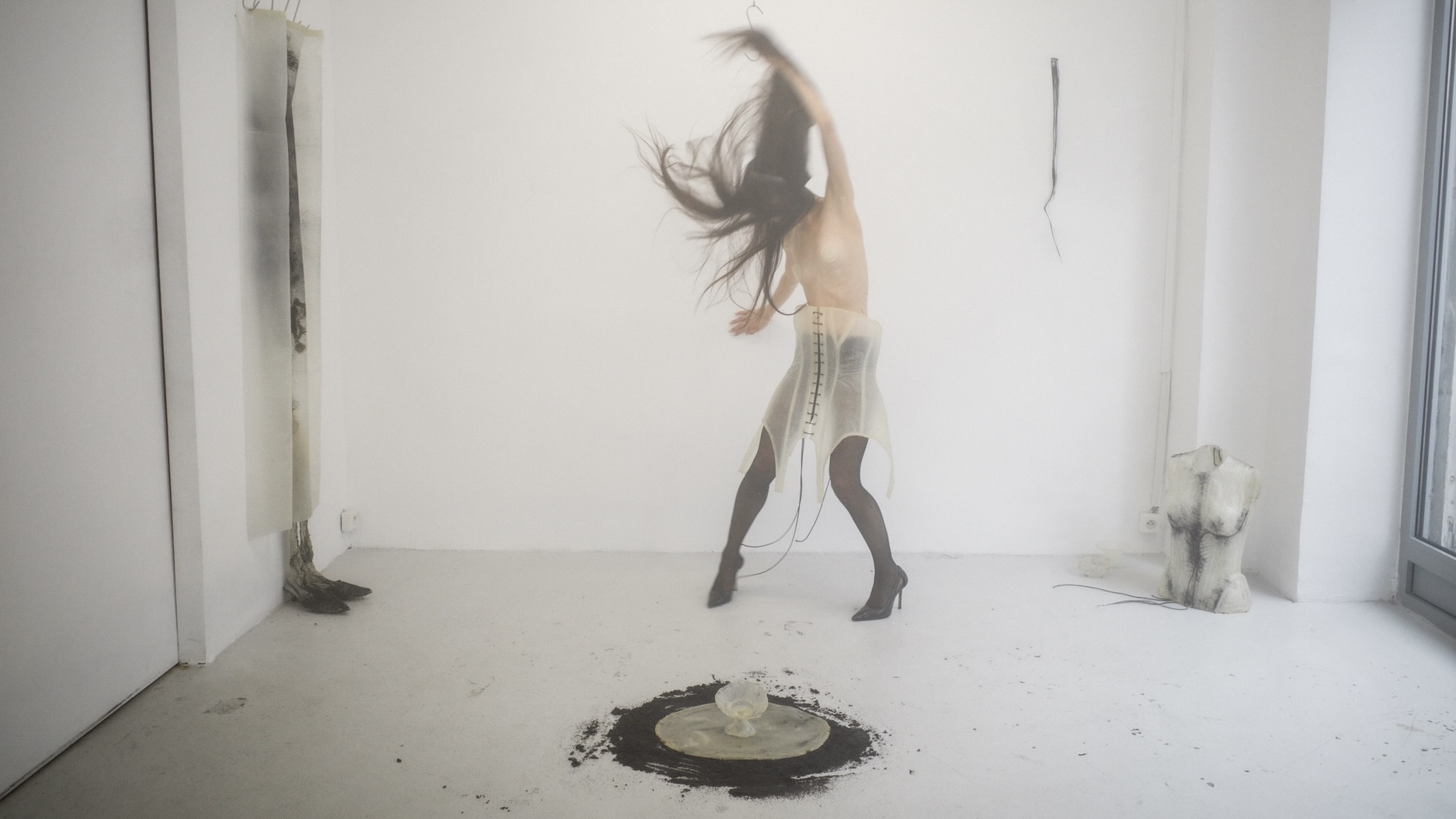
JG: It always depends on who wears it, how and in what context, I would say. I’ve also worked with dancers, for example, and it’s fascinating to see how the material transforms through movement and tension. It suddenly takes on a completely different shape and character. It’s almost as if the garment becomes a separate entity, responding to the body and movement in its own way.
EL: What has your work taught you?
JG: Quite a lot, actually. There is still so much to learn from the material itself, especially when it comes to testing its limitations. I find the whole process incredibly exciting because I’m constantly discovering something new.
But on a personal level, it’s also taught me a lot about my own limits. So much happened all at once last year, and I’m still learning to set boundaries and say no. I tend to think, “How can I make this work?” because I genuinely want to make things happen. But sometimes that means pushing myself too far.
So I guess while I’m constantly trying to push the boundaries of the material, I’m also learning to respect my own.
EL: You’ve developed a very distinctive way of working with latex, and it seems that others have started copying your approach. How do you feel about that?
JG: First of all thank you for noticing. I don’t really know how to put it gracefully, but honestly, it is incredibly frustrating. You spend years experimenting and developing something, finding your own way of working with a material, and then suddenly you start seeing very similar things appearing.
Of course, nobody owns a material or a technique, but I think there’s a difference between being inspired by someone’s work and reproducing an almost identical visual language. And that’s the part I find difficult. But, just because something looks similar doesn’t mean it actually is. The materiality, the way it feels, behaves and responds to the body can be completely different. My approach involves various processes. It’s not simply about applying latex to a surface and peeling it off. I’m interested in manipulating the material itself, changing its properties, structure and behaviour. There are years of experimentation behind these processes that aren’t necessarily visible from the outside.
I can’t control what others do, but I can continue developing my own work. And in a way, it’s pushed me to think even further about where I want to take the material next.
EL: During last Paris Fashion Week, you presented Omen, an artistic project combining latex creations, an installation and performance art. What was that experience like for you?
JG: It was a completely new experience for me. I’ve worked with performance artists before, but this time I planned and directed everything myself, creating an entire environment around OMEN. It was exciting to see how the garments, objects and performance could come together within one space.
In the end, it felt almost like a little community. We even had everyone draw a tarot card representing the energy of the day, which was a lovely moment.
We always meet such interesting people in Paris, and it was really wonderful to feel how supportive everyone was. What I enjoyed most was that people could experience the works in person, touch the materials, ask questions and
engage with them beyond just seeing images online. For me, that’s really what matters, bringing people together and exchanging ideas.

WEEKEND MUSIC TIP PT 116 JAY PARK AND LNGSHOT
From shaping the K-pop scene to mentoring the next generation, Jay Park is taking LNGSHOT…
IN CONVERSATION WITH LANGSTON UIBEL
Langston Uibel is an actor moving beyond the frame and finding new ways to tell stories.…
WEEKEND MUSIC TIP PT 115 ACID PAULI
Martin Gretschmann, better known as Acid Pauli, has spent decades moving between musical…
EDITORIAL
With Built to Belong, designer and stylist Elisabeth Kiko explores the idea of creating…
ON OUR RADAR
Numéro Berlin’s weekly collection of the most exciting news about fashion, music, and…

IN CONVERSATION WITH IMAN TAHERI & CONROY CHAN
In conversation with Numéro Berlin, Conroy Chan and Iman Taheri discuss creative…