
EGOS ON “RUHRPOTTKINDER“, POLITICAL RESPONSIBILITY IN MUSIC AND THEIR LOVE LETTER TO HOME

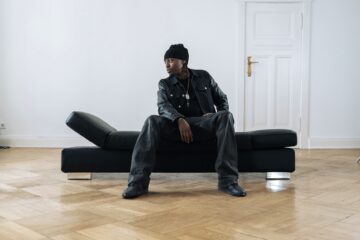
Rap duo EGOS consists of bluejeans and Uwe R., two up-and-coming rappers from the Ruhr area. Their music ranges from angry truths yelled out, as in „FREE LUIGI“, to diary-like, deep reflections in „Kalter Krieg“. The name should not be misunderstood, as these two are far from egocentric: recurring elements in almost every song are political injustices, the concerning rise of the right (not only) in Germany, and shedding light on the ambivalence of their own consumption habits. Whether as a duo or on solo projects, they are slowly but surely making space for themselves within Germany’s rap scene.
Their new album „Ruhrpottkinder“ is both a love letter and a concluding reckoning with their home region, as new destinations appear on the horizon for EGOS.
In conversation with Numéro Berlin, the two talked about the hidden charm of their city, the political responsibility and reach of music, and what they continuously learn from each other.
Uwe R:
Broadly speaking, it’s about home, friendship, drugs, and partying.
bluejeans:
Growing up. Somewhere along the way, growing up and Weltschmerz, yeah. Just the things you do here and the things that occupy your mind here, you know?
B:
First of all, I don’t think it’s actually that much, but it is a huge urban area and you definitely have everything here, but somehow also nothing. I don’t know, the Ruhrpott – you really have to look for things if you want to go out partying somewhere. You have to actively look. It’s not like you have endless options every day for what to do. If you want to go out, you have to get together with people and find a function to go to, some kind of event. It’s very much shaped by the working class here. Although by now, parts of it have become extremely gentrified. And it’s this wild mix of very closed-off circles, but also really open people who will just come up to you and talk to you, either in a nice way or sometimes not so nicely.
U:
I think the difference between the Ruhrpott and other parts of Germany is that the Ruhrpott is simply more direct. It’s more honest than a lot of other parts of Germany. It’s like a kind of cold warmth.
B:
Yeah, very much speaking your mind. But people are also often pretty fucked up. Still, you always know where you stand with people. And I think when you grow up here, on the one hand you have this kind of small-town thing where you’re always hanging out with the same people at the same playground, but once you get older, you also always have people from another city around. They might only be 20 minutes away by train, but it’s immediately a different city.
B:
I think that fundamentally, whenever we record a song, we’re both willing to release it. For me, it was really only the first song that was difficult to put out. Since then, I haven’t had a problem presenting my feelings and my emotional world in songs, because I also kind of push them away from myself by doing that. I write them down and… Once it becomes a song, it creates a certain distance from those feelings, and once the song comes out, I can sometimes, especially if they’re negative things, let go of them a little bit.
So there weren’t really any songs where I’d say, “I was scared of releasing that” or “I didn’t feel comfortable with that.” But of course there are songs that are much more honest and personal, and then there are other songs where consuming and partying are more in the foreground. For me, for example, “Gesundes Essen” is a song where we’re both very honest.
U:
Yeah, that would probably be the song that was the most difficult for me, in a way… “Unterkühlt” as well. But I don’t know, those are just things I would tell anyone. They’re not things I keep secret or anything. I don’t know, I don’t put secrets on tracks, otherwise they wouldn’t be secrets anymore, right?
B:
Exactly. But yeah, in “Gesundes Essen” you have a very honest part where you really look at your own consumption honestly, which isn’t something you normally share with everyone, something you don’t usually put out there. And when you’re honest about yourself in a song, you often have to admit certain things to yourself as well. And I think we both give a really deep insight there that I wouldn’t just throw in everyone’s face, despite the honest Ruhrpott mentality.
“I think the difference between the Ruhrpott and other parts of Germany is that the Ruhrpott is simply more direct.“


U:
When we’re writing a song, it usually goes something like this: someone has an idea and thinks, “A part from the other person would be sick on this.” Or we sit together in a session, have a beat or something, have an idea, and then simply write a song around it.
B:
Yeah, often Uwe already has a hook written and a verse, and there’s just one verse missing, so I jump on it, or vice versa. Or someone shows the other person a song where it wasn’t even planned for the other person to be on it, and then there’s another minute of space on the beat. And maybe you have some lyrics lying around in your notes that fit perfectly, so you don’t even write something specifically for it.
It naturally develops this kind of structure where either I get into Uwes’s car and we take a trip, or vice versa. But basically, you can’t say that we have some kind of completely planned-out approach to it. In the end, and I think that’s the beautiful thing about making music with you, it’s simply hanging out and making music. It’s not like, “Okay, here’s an open verse from someone and I have to write something on it and it has to be crazy good…” We started writing together. So there’s nothing that feels more natural than making music with Uwe.
U:
We argue sometimes, and then we basically throw whatever’s on our minds at each other. We give each other a really clear piece of our mind, and then we make up, hug each other and say, “Hey, sorry, I didn’t mean it like that.” and then everything’s fine again.
B:
Yeah, I don’t even know if you could call it arguing. We’re both very, very empathetic and sensitive characters. And I think that when there’s tension between us these days, it often builds up over weeks. It’s kind of passive in the background, because it’s usually things we haven’t talked about.
We both also still have to deal a lot with patriarchal socialization in the way we interact with each other. And then sometimes we have these moments where, in a really long conversation, we look back over the last two weeks and work through everything, and then we fully reconnect again.
And through that, you get to a point where you’re much closer because you managed to overcome this toxic masculinity together. I didn’t admit my weakness in that moment or say, “Hey that really hurt me and I didn’t like that,” and because of that, it turns into something that one of the two people carries around alone.
It’s never like we have some crazy disagreement where we clash and start insulting each other. But when we’re both stuck in our own stubborn mindset, it can also be difficult to move away from our position sometimes. But still… I always know that he doesn’t mean it in a bad way, and I think the same goes the other way around. There’s never any real bad blood. It’s just relationship work that you have to put in.
B:
That’s difficult, because we’ve always made music together. I think so much of it comes from the same pot, and sometimes I notice that I write a song and there’s a flow in it that I heard from Uwe two months ago, and low-key that’s why it was in my head. So then I adopted it. Or sometimes Uwe writes a track and there’s a similar rhyme scheme in it, or vice versa. It’s just difficult when you’re always making music together, or a lot of music together.
But in general, I think I sometimes have a bit more of that classic, angry hip-hop stuff and…
U:
I want to try doing something a little different more often.
B:
Yeah, and I think because I’ve released more music and gotten more feedback from outside, I’ve also found a somewhat more concrete style. But sometimes I completely break out of that because Uwe has written a part where it wouldn’t work for me to come in with my usual style, so I do something completely new instead.
That’s how these really swingy things come about, like “Nur ein Leben,” for example. I have to step out of my comfort zone a bit so that it fits on Uwe’s canvas. And then I can reinvent myself a little through that, I think.
U:
I also have a lot of those SoundCloud 2016 influences – a bit more towards autotune, mumble, sing-song stuff.
B:
And I have more of that classic hip-hop, rap thing. Just more angry, I guess.
U: Yeah, that bluejeans always follows through. He says he’s going to do something and then he just does it.
B: I try to learn a lot from Uwe about thinking first and speaking afterwards, because Uwe is definitely much better at that than I am. I always follow through, but I also immediately follow through with everything, and I often immediately push my opinion in conversations without thinking about it enough. Because of that, I also clash with people more often than I want to, or I overshoot the mark in the way I deal with people who mean a lot to me and the way I talk to them.
So there’s definitely something I can learn from Uwe: bringing that tolerance that I live by to the people who are very close to me as well, maybe listening first before I speak, and understanding a little more that people are simply different from me. Even if I really like people and get along with them very well, they’re still different characters, and I need to hold myself back a little bit.
U: Damon Albarn. The annoying thing is that there are a lot of artists I used to love but cańt support anymore. I listened to people like Yung Hurn and Jonny5 a lot and for sure took some inspiration from them, but with everything that came out now, I can`t support them as people anymore. Apart from that, A Tribe Called Quest, definitely. They’re also a huge inspiration for me.
B: For me, I’d name Filu, Longus Mongus and Shake One as inspirations. I definitely can’t leave Makko out either. No matter how I feel about him now, he was the person who showed me, “You can also rap as a white boy without any motion.”
Because when I started writing, I listened to a lot of gangsta rap, but I was never from the streets. So it would have been completely inauthentic for me to write about that. But he was the first person who wrote about Weltschmerz and his insecurities in a cool way.
B: You don’t have to suffer, but strong feelings produce strong lyrics. Whether it’s huge joy about something, or whether you’re madly in love, or whether you really can’t stand your everyday life right now and don’t want to get out of bed.
Whenever you have something you need to get out of yourself and process, I think you can make good art out of that.
I’d also like to add to this: I somehow can’t really take artists seriously who are completely apolitical in their music and don’t use the voices they have. Of course, you also have to be able to just make music, but I think it’s incredibly cringe when people who have, like, five million listeners and that kind of reach don’t use it to explicitly speak out publicly even once.
For example, Makko or Souly – they have voices with enormous reach. And sure, you’d probably consider them left-leaning, but how left-wing are you if you have five million listeners and don’t use your voice to push back against fascists?
And that’s why I’d like to give shout-outs to people like PTK, YGT and Dietrich, people who simply stay real.
B: I think it will influence my music in the sense that I make my best music when I’m developing further in my life. And it wasn’t primarily about moving to Hamburg. It was more about the fact that, even though I have so much love for the Ruhrpott, I simply had to get out for a while.
I’d been here for 23 years, I’d seen everything, I felt like I knew every corner and every person, and I simply realized that over the last year, my surroundings weren’t really inspiring me anymore.
And I think as long as I continue developing as a person, my music will develop as well. And obviously Hamburg will also connect me with new artists in practical terms, and there are a lot of creative people there.
But overall, I think the bigger aspect is that I can grow a lot as a person there now, because I can find new circles, I have a lot of new possibilities, and I’m simply somewhere else where everything is new and I can partly reinvent myself.
With the album, I’ve basically put everything I had to say about the Ruhrpott and Essen onto this album, pretty conclusively. Yeah. And anything I did from now on would just repeat itself. I’d spend the next five years rapping about how I’m not doing well or how I’m doing well, and how I’m still hanging out in the same places here and seeing people I already know.

“How left-wing are you if you have five million listeners and don’t use your voice to push back against fascists?“


U: Paying off my debts to the producer and then recording new songs.
U:
I wouldn’t actually call it inspiration. But what’s really great about working with your hands, for me at least, is that you can kind of fall into a trance.
B:
Your head completely switches off.
U: Yeah. You’re just working and somehow you feel like your head is clear. When you’re listening to beats or just thinking, lines often just come to you. Topics come to you, songs you want to write come to you. So in that sense, I’d say I do get inspiration from it, but I’m not writing lyrics about landscaping or anything.
B:
I do let it flow into my music a little. It’s the best job I could be doing right now, but I also don’t want to do it for the rest of my life.
And I’m noticing it right now, because I’m working on a construction site again after taking a year or two off. It definitely motivates me to make music, because I know that I don’t want to be working on construction sites at 40.
There’s nothing right now that interests me enough that I’d want to study it. And what Ben just said is really true, too. You get into this flow when you have a task, and then you don’t notice that three hours have passed because you’re completely focused on the task.
But you’re not so focused that your brain can’t keep working. While you’re focused enough to do the job well, you still have some space in your head to really give yourself over to your thoughts and have four lines just spill out of your head. And sometimes you have to sit down for a second and think, “Okay, I need to write this down now.” One advantage, and one reason I’m also glad I did this job, is that the job stays at work. The construction site doesn’t come home with you. Sure, sometimes my boss calls me and asks what happened, whether we managed to do this or that, but it’s a maximum ten-minute phone call, and I don’t have to keep dealing with what’s happening at work after I leave. It gives you very structured working hours, and then you have your free time completely available to devote yourself to art.
U: As far as rap is concerned, there’s basically nothing that I would completely rule out or say I wouldn’t want to try at some point. And in terms of topics, there isn’t really one specific thing either, because it’s difficult to predict what’s going to happen to you next in life.
I either talk in music about what happened to me, what I’ve been through, what’s currently occupying my mind, or what I’m seeing in the world right now. And yeah, you can’t really predict that.
But what I’ll definitely keep exploring is the 2016 SoundCloud era. I love it. It’s just such a beautiful sound to me.
B: I feel pretty similarly about that. Because what I write is always kind of a diary of myself, it’s difficult to influence it. It’s always shaped by what’s shaping me and what I’m feeling at the moment.
But right now, hip-hop has me by the balls more than ever, and I really want to rap some proper in-your-face hip-hop over old-school beats. And maybe slowly start working on a bigger solo project, and over a longer period of time… just collect music, maybe make an EP.
But at the same time, I’d also really love to do some, I don’t know, autotune, dude, really huge vocal lines, really swingy, really stupid-fun stuff.
I’ve written a few tracks recently that go a bit more in a party direction, that cheeky Blue Jeans. But genre-wise, I’m up for anything. That’s what I love about our music right now: we haven’t boxed ourselves into anything.
I’ve dropped some songs and then gotten feedback that it’s the genre and style that suits me best so far. And those songs have also done the best so far. And then I felt a little pressured to recreate that.
But as soon as you start trying to recreate what worked, it’s not me anymore, because I don’t make music like a product. I don’t create products. It’s a product of myself, and I can’t really control that.
So I’m open to everything, and I’m up for anything that I enjoy and that I feel comfortable with.

WEEKEND MUSIC TIP PT 106
Betty Hammerschlag’s music exists somewhere between memory and invention. Her upcoming…

THE CULTURE WE CARRY: INSIDE MS. LAURYN HILL’S DIASPORA CALLING!
At Diaspora Calling!, Ms. Lauryn Hill transformed the Milton Keynes National Bowl into a…
WEEKEND MUSIC TIP PT 104 BOONDAWG
Whether it be headbangers such as “Gangsigns“, prayer-like reflections in “Ghetto…

INSIDE THE MACHINE: POL CHAMORRO ON BUILDING LÍO’S HALFTIME SHOW
Halftime Show, a production that trades the language of classic cabaret for the scale and…

WEEKEND MUSIC TIP PT 103 CHARLIZE
It takes a good amount of self-reflection and emotional intelligence to recognize your own…

ON TOP OF THE WORLD: HOW YE’S CONCERT REFRAMED ALBANIA’S CULTURAL FUTURE
Few artists have shaped 21st-century culture as profoundly as Ye. The Tirana performance…